
A 55-year-old with COPD exacerbation has received 3 days of bronchodilators, steroids and controlled oxygen with improved wheezing, lower respiratory rate from 28 to 20, SpO2 92% and stronger cough. The physician asks whether bronchodilator frequency should change. Which therapy decision about adding, modifying, continuing or discontinuing therapy best fits this improving patient?
Select an answer to reveal the explanation.
Short Explanation
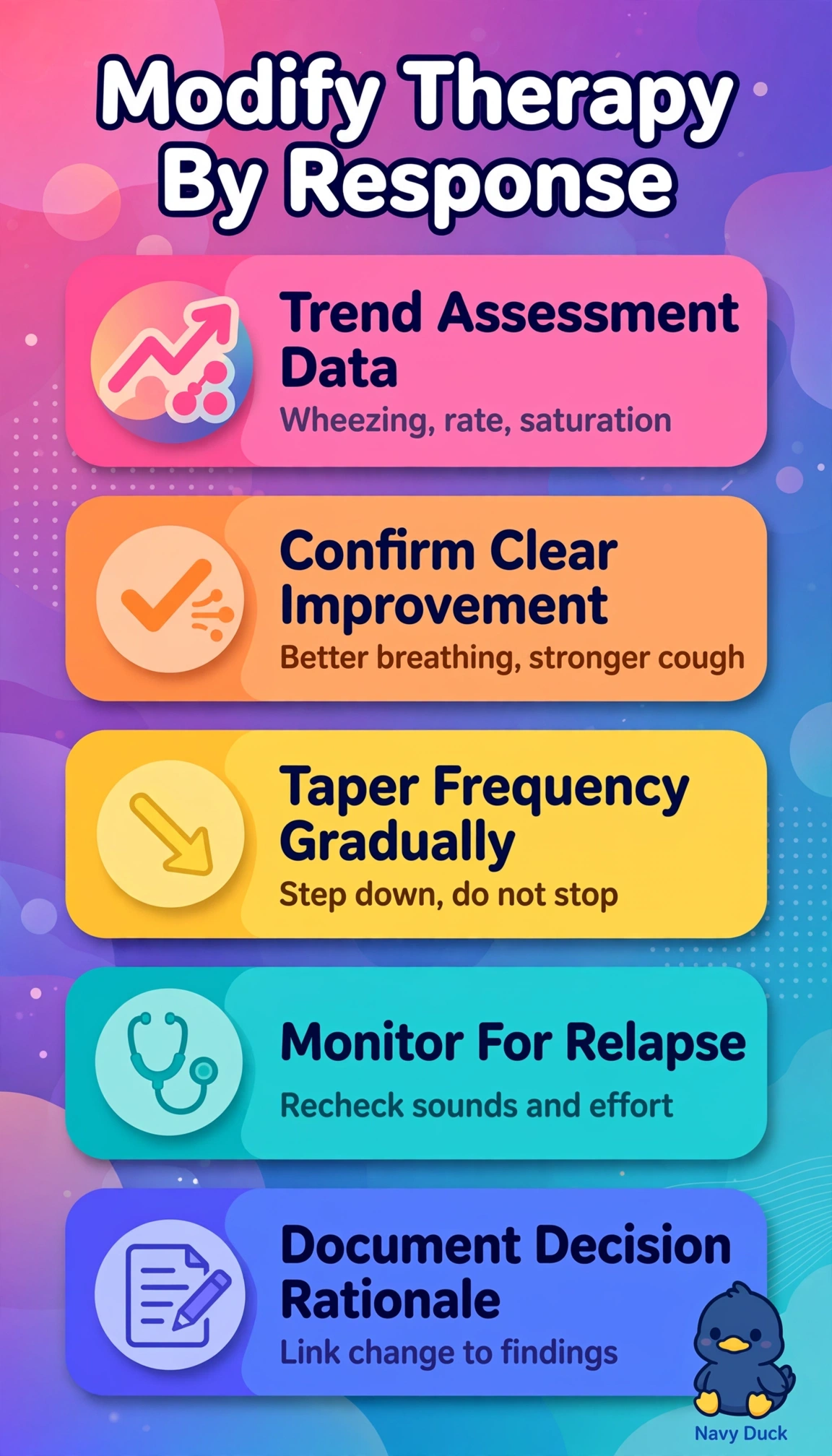
You're watching someone turn the corner, so stepping therapy down matches their progress. This kind of taper honors judgment by matching treatment intensity to real clinical improvement.
Full Explanation
Clinical decision making requires matching therapy intensity to reassessed patient response, and when wheezing decreases, rate normalizes, saturation stabilizes and cough strengthens, evidence supports tapering bronchodilators rather than abrupt stop or indefinite continuation, with ongoing monitoring to detect relapse. Continuing unchanged frequency overlooks documented improvement and misses the opportunity to de-escalate safely, which the question asks you to decide. Adding chest physiotherapy introduces a secretion-clearance modality without retained secretions, atelectasis, or weak cough as indications, so it adds burden without benefit. Discontinuing all bronchodilators immediately overreacts to improvement and risks rebound bronchospasm because the exacerbation has improved but not resolved. Exam caveat is to base continue, modify, or stop decisions on trended assessment data rather than a single symptom, and practical check is to reassess breath sounds, work of breathing, and SpO2 after any frequency change.