
A 68-year-old post-surgical adult is stable on a medical floor, breathing comfortably on 2 L/min nasal cannula with SpO2 97%, respiratory rate 16 and clear lungs. The hospital respiratory-driven protocol targets SpO2 92-96% for stable non-ICU patients and allows titration without new orders. Which respiratory-driven protocol step for oxygen titration should the therapist implement next?
Select an answer to reveal the explanation.
Short Explanation
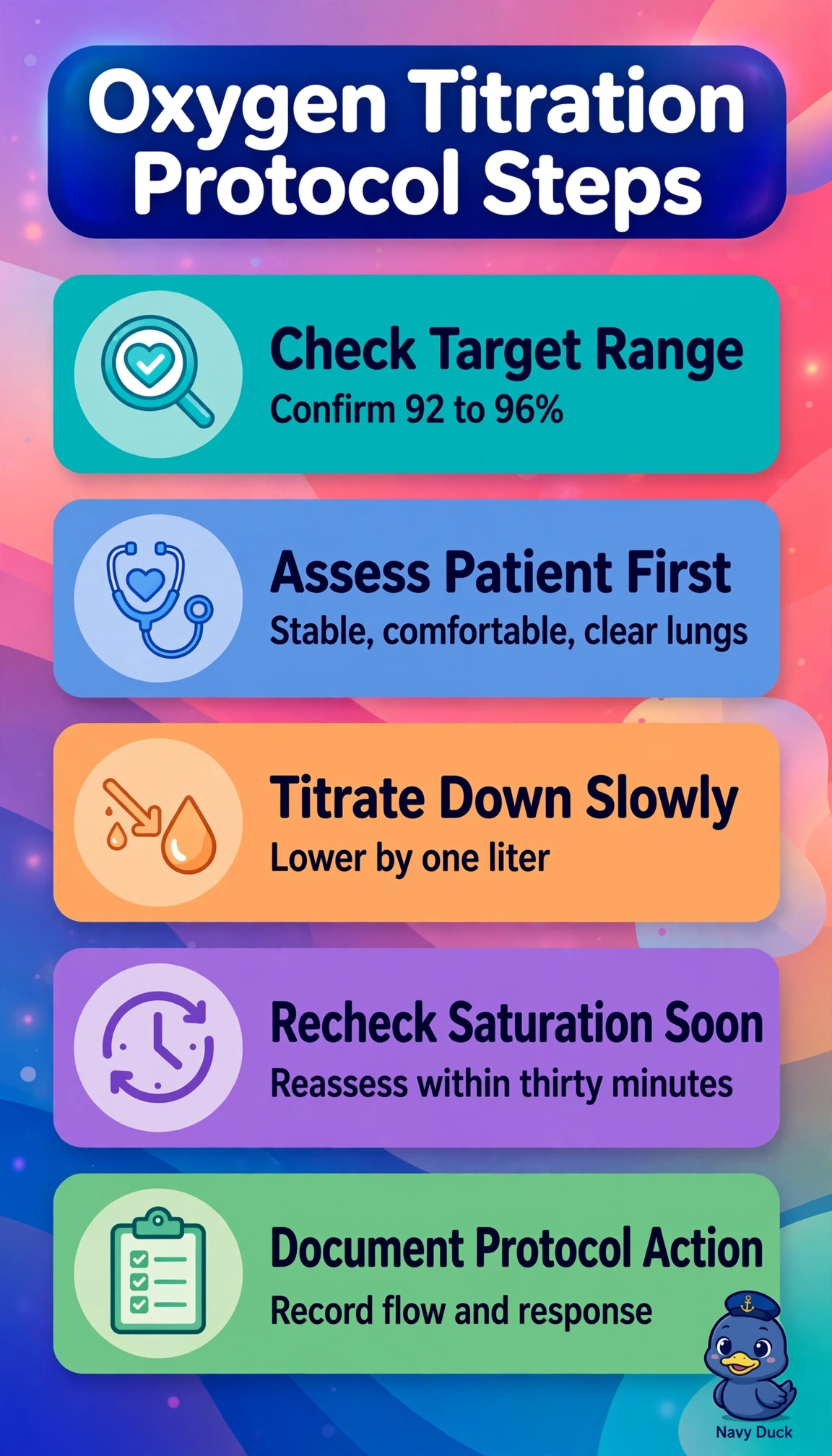
You've got a stable patient sitting above target, so easing oxygen down is textbook stewardship. Tight titration keeps you in that sweet protocol window without overshooting into hyperoxia.
Full Explanation
The correct step is appropriate because the patient is stable, comfortable, breathing at 16 with clear lungs and SpO2 97% on 2 L/min, which is above the stated respiratory-driven protocol goal of 92-96% for stable non-ICU patients, so a small downward titration with prompt re-evaluation safely corrects mild hyperoxia while confirming continued stability without needing new orders. Discontinuing oxygen entirely despite the correct recheck interval fails the concept of gradual titration in a stable postoperative adult, because abrupt removal after low-flow support risks rebound desaturation and obscures the minimal effective dose, even though liberation from oxygen is otherwise desirable. Reducing to 1 L/min but waiting until the next routine vital-sign cycle fails the concept of timely post-intervention monitoring, because any titration requires close reassessment to detect drift above or below target and to guide the next protocol step rather than routine surveillance. Reducing to 1 L/min with a 30-minute recheck but aiming for 88-92% fails the concept of correct target selection, because that lower range is reserved for patients at risk for hypercapnic respiratory failure and would leave this stable non-ICU patient intentionally below the ordered 92-96% window. An exam caveat is to anchor every titration choice to the target range printed in the stem rather than defaulting to disease-specific ranges or assuming higher saturation is always safer. A practical check is to verify comfort, rate, work of breathing and repeat pulse oximetry within the specified window before making any further protocol adjustment or notifying the team.