
A 62-year-old is on volume control ventilation day 4 for pneumonia, now afebrile with FiO2 0.40, PEEP 5, stable pressure, alert and triggering breaths with adequate cough and minimal secretions. The team wants to advance liberation today during daytime staffing. Which liberation strategy should the therapist initiate to assess readiness for extubation?
Select an answer to reveal the explanation.
Short Explanation
You nailed the core liberation skill here — less support reveals true readiness. Daily low-support trials test the patient, not the machine, and beating readiness criteria predicts extubation success.
Full Explanation
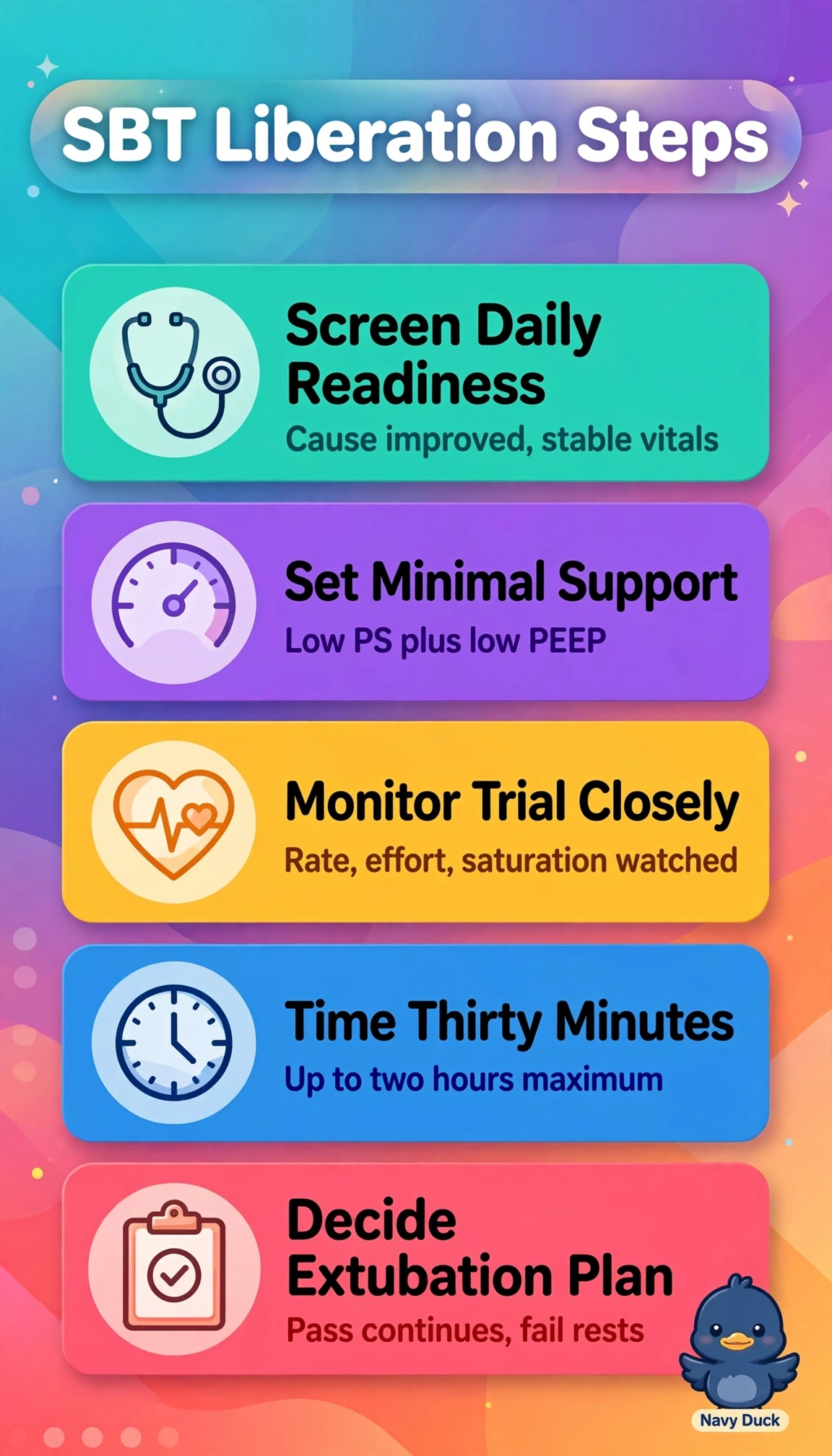
The patient meets standard readiness with resolving pneumonia, afebrile status, FiO2 0.40, PEEP 5, stable pressures, alert mentation with spontaneous triggering, adequate cough and minimal secretions, so guidelines support a daytime 30- to 120-minute spontaneous breathing trial using minimal pressure support and PEEP to test sustained spontaneous ventilation, airway protection, and tolerance while staff can monitor closely and promptly resume support if needed. Proceeding directly to extubation to prophylactic noninvasive ventilation fails by assessment concept because prophylactic support can reduce postextubation failure in selected high-risk patients after a passed trial but cannot replace the trial for determining readiness, leaving tolerance unknown and increasing reintubation risk. Recommending early tracheostomy fails by trajectory concept because tracheostomy is reserved for anticipated prolonged ventilation, repeated trial failure, or prolonged inability to protect the airway, typically after 7 to 14 days, whereas this patient is only day 4 with improving disease and favorable predictors. Starting gradual pressure-support weaning while maintaining full support fails by strategy concept because slow decremental weaning prolongs ventilation, sedation, and pneumonia risk when prompt assessment is indicated and it provides no standardized pass-fail test for extubation readiness. For exams, meeting weaning criteria only qualifies the patient for a trial and passing the trial qualifies for extubation, so do not conflate screening with testing. Practically, verify mentation, cough, secretions, hemodynamics, and gas exchange, then perform the timed minimal-support trial in daytime with continuous monitoring of rate, volume, saturation, blood pressure, work of breathing, and comfort, stopping for standard intolerance signs.