
A community hospital and three local skilled nursing facilities notice that 30-day hospital readmissions from those facilities remain high, yet hospital teams blame facility staffing while facility nurses blame incomplete hospital discharge orders. Which care transition practice best addresses these shared breakdowns?
Select an answer to reveal the explanation.
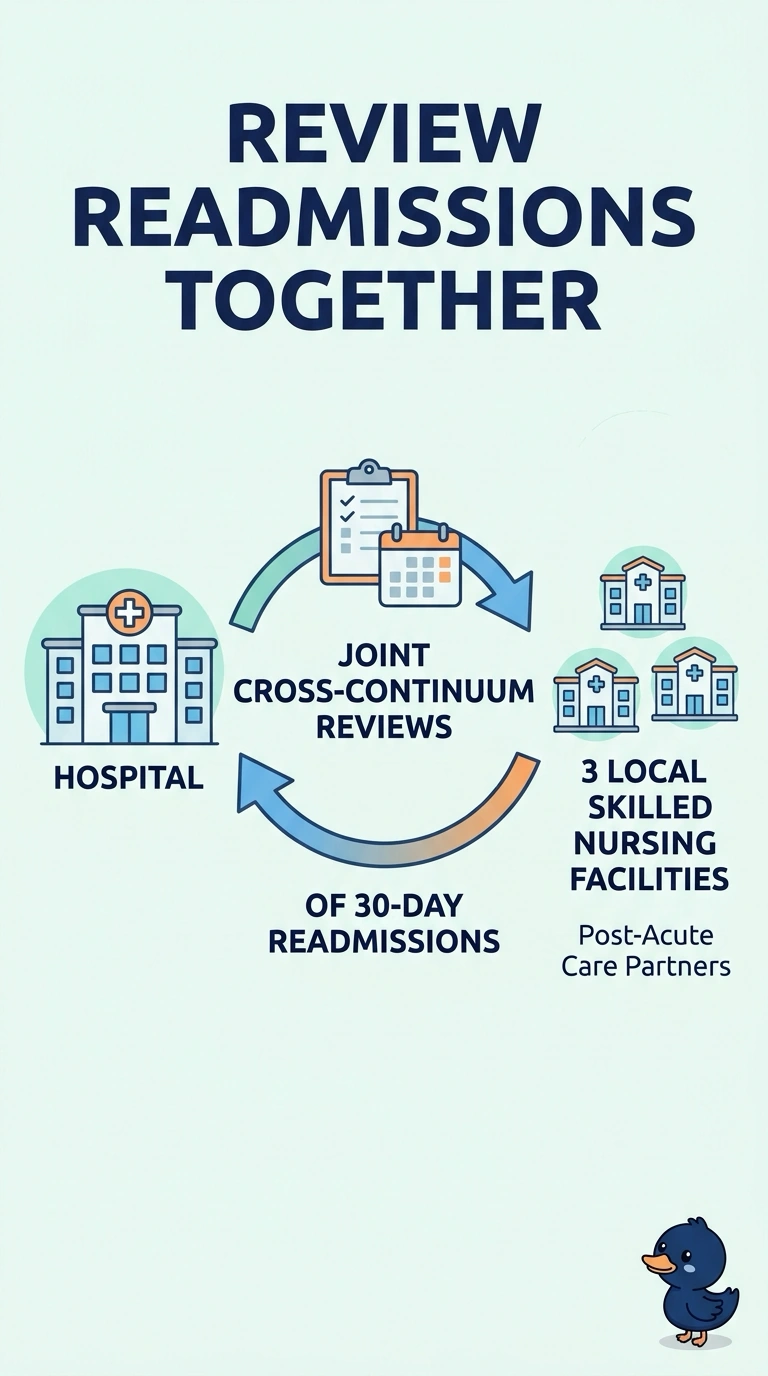
Short Explanation
Blaming the other side of a hospital-to-facility handoff never kept a single patient out of the emergency department. When you run joint cross-continuum readmission reviews with post-acute care partners, both teams see where medication lists or care instructions break down. Avoid the trap of punitive penalties or one-sided audits that damage care access without fixing the handoff.
Full Explanation
Conducting "Joint cross-continuum readmission reviews with post-acute care partners" addresses care transition failures as shared system problems rather than isolated organizational faults. By bringing hospital case managers, physicians, and skilled nursing facility nurses together to review actual return cases, teams uncover missed medication reconciliations, delayed clinical summaries, and unclear escalation triggers. Conversely, "Penalizing skilled nursing facilities financially for every 30-day hospital return" creates defensive blame-shifting and discourages facilities from accepting medically complex patients. Similarly, "Station a hospital case manager at each skilled nursing facility to review new admissions once a week" offers only intermittent, resource-intensive oversight that misses real-time handoff errors and early clinical changes. Finally, "Auditing inpatient length of stay and discharge-order completeness on hospital units" misses the critical handoff window where most early transition breakdowns occur. One caveat is that shared case reviews must protect patient privacy under HIPAA minimum-necessary rules and focus on process redesign rather than finger-pointing. As an operational check, track the percentage of hospital-to-facility transfers with completed nurse-to-nurse handoffs and verified medication lists within 24 hours.
Prefer to study offline? Printable PDF study book + test engine ($7.50, unofficial). These questions stay free here.