
A primary care clinic maps its referral-to-specialist scheduling workflow and finds that actual staff work takes 18 minutes across four steps, while patients wait 14 days in electronic queues between handoffs. Which Lean metric best highlights this delay for the improvement team?
Select an answer to reveal the explanation.
Short Explanation
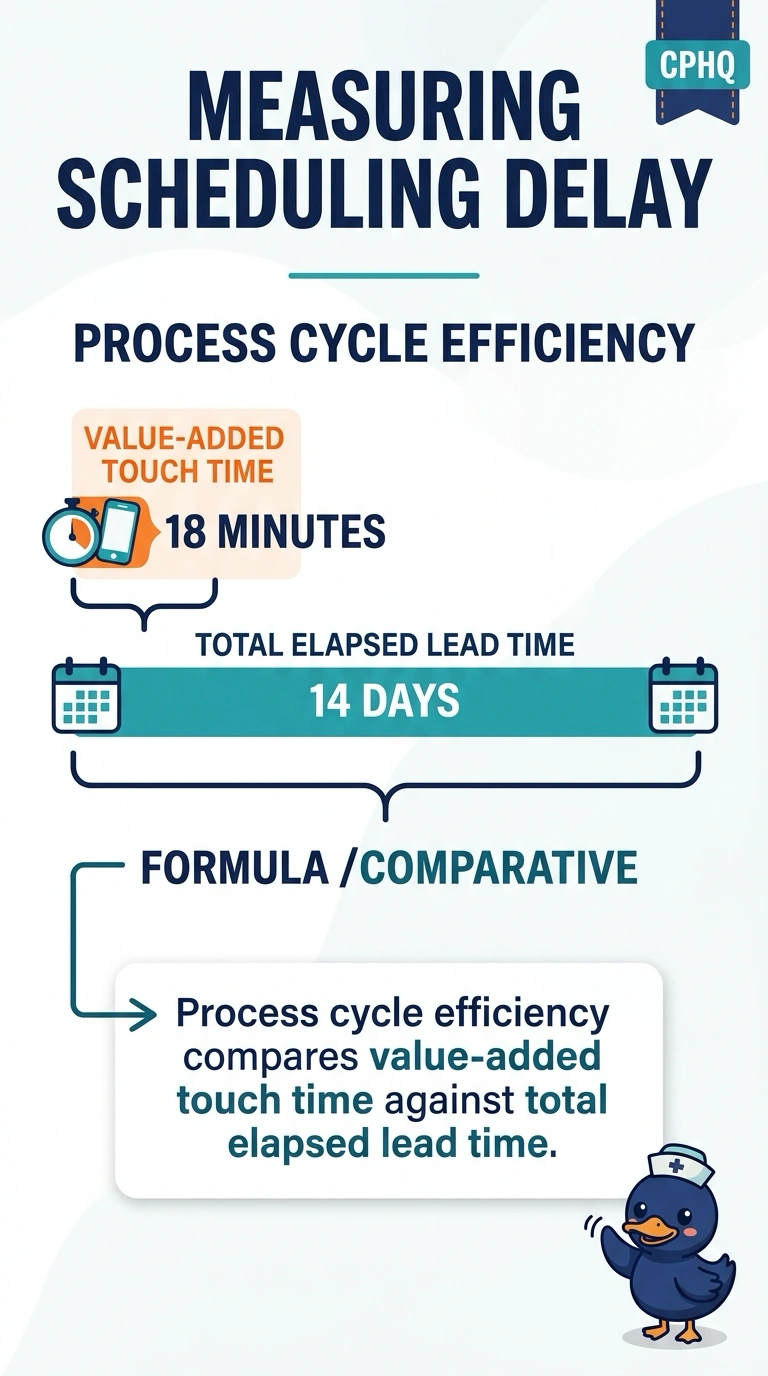
Eighteen minutes of actual work buried inside a 14-day wait is a classic hidden queue problem. You make that delay visible by tracking process cycle efficiency comparing value-added touch time against total elapsed lead time. Avoid the trap of measuring busyness, such as staff phone utilization or raw referral volume, which misses how long patients actually wait.
Full Explanation
Using "Process cycle efficiency comparing value-added touch time against total elapsed lead time" exposes the huge gap between active processing and queue wait time in Lean value-stream analysis. Dividing 18 minutes of value-added work by 14 days of total lead time yields a fraction of a percent, immediately showing leaders that speeding up clerical typing will not fix a two-week handoff bottleneck. Tracking "Daily referral volume comparing total incoming orders against clinic staffing" measures demand and capacity balance but does not quantify where time is lost inside the workflow. Measuring "First-pass yield measuring how many referrals contain complete diagnosis codes" evaluates rework quality at intake rather than elapsed queue delays across handoffs. Monitoring "Staff utilization tracking the percentage of scheduled hours spent on phones" risks encouraging busywork and ignores patient-experienced waiting between steps. One caveat is that teams must agree on strict operational definitions of value-added time versus non-value-added wait time before calculating the ratio. As an operational check, time-stamp each referral handoff from order entry to scheduled appointment and recalculate process cycle efficiency after removing batch queues.
Prefer to study offline? Printable PDF study book + test engine ($7.50, unofficial). These questions stay free here.