
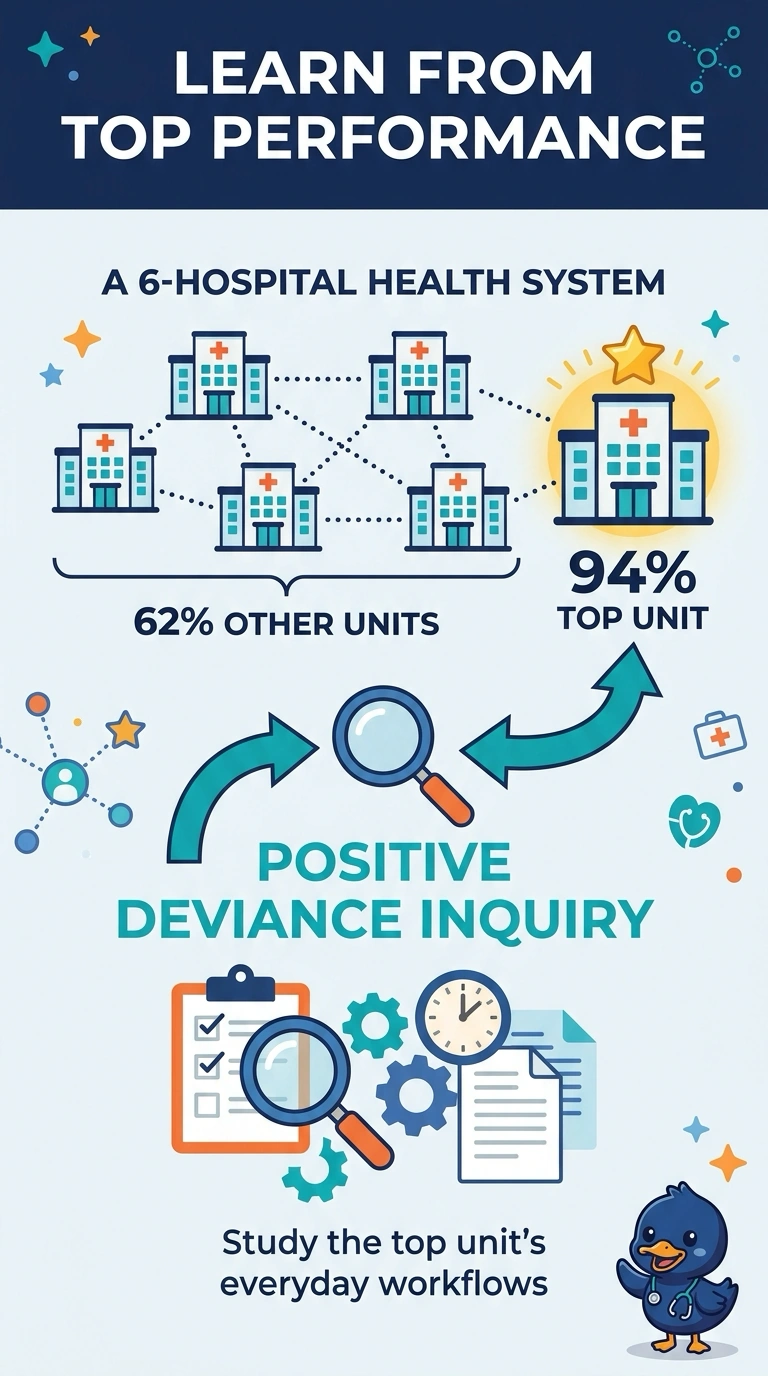
Across a six-hospital health system using the same electronic health record and staffing ratios, one medical unit consistently achieves 94% hand hygiene compliance while five other units average 62%. Which improvement approach leverages the high-performing unit's internal success?
Select an answer to reveal the explanation.
Short Explanation
Before you pay an outside consultant to reinvent the wheel, look down the hall at the team already solving the problem with the exact same tools. The trap is assuming low performers just need harsher targets or a generic playbook. Using positive deviance lets you uncover practical, homegrown habits that other units can realistically adopt.
Full Explanation
Studying the top unit's everyday workflows through positive deviance inquiry works because it identifies how an internal team facing identical resource constraints and electronic health record tools achieves superior outcomes through distinct local behaviors, such as huddle routines or supply placement. Because those solutions already thrive inside the organization's real-world environment, peer units are far more likely to adopt them. Adopting a generic external consulting template for hand hygiene across the six hospitals wastes time and ignores proven internal solutions that already fit the health system's culture. Placing the five lower-performing units on formal performance improvement plans with monthly review relies on punitive pressure rather than addressing workflow barriers, which drives underreporting without fixing process design. Raising the compliance target to ninety-eight percent across all six hospitals first simply moves the goalpost without giving struggling units any practical method to close the gap. As an exam caveat, positive deviance still requires testing whether the high-performing unit's practices can be adapted to different unit sizes or patient acuity levels. As an operational check, conduct structured gemba observations on the 94% unit and co-design a small-scale pilot with one lower-performing unit.
Prefer to study offline? Printable PDF study book + test engine ($7.50, unofficial). These questions stay free here.