
An outpatient imaging center wants to increase daily MRI completions. Adding a second front-desk registration clerk speeds up check-in, yet total daily scans remain unchanged because the single MRI scanner runs at full capacity all day. What does this illustrate?
Select an answer to reveal the explanation.
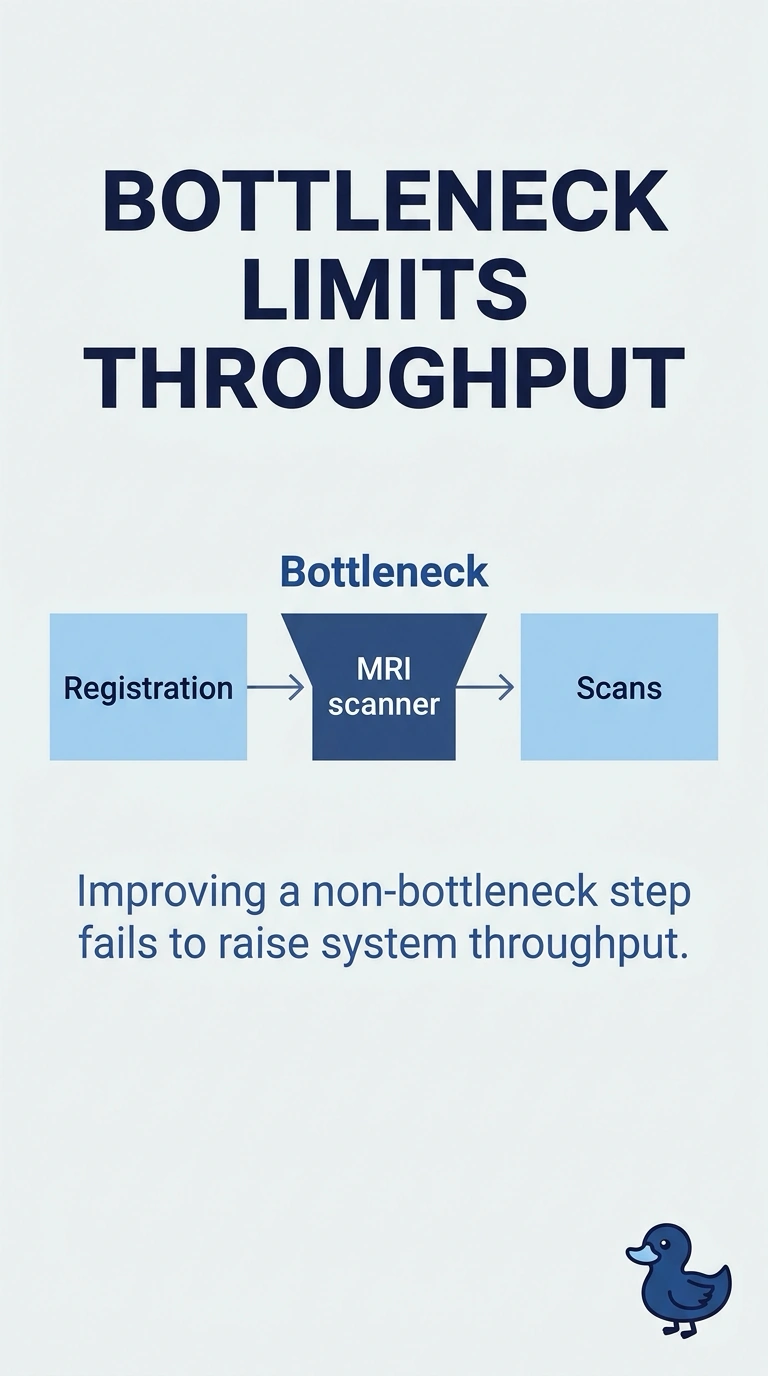
Short Explanation
Speeding up the highway tollbooth does not get more cars through a one-lane bridge up ahead. When you optimize a step that is not the constraint, work just piles up faster in front of the real bottleneck. The trap is assuming any local efficiency gain automatically boosts total system output.
Full Explanation
Improving a non-bottleneck step fails to raise system throughput reflects the core principle of the Theory of Constraints: overall process output is governed by the single slowest or most capacity-constrained resource, in this case the lone MRI scanner. Adding capacity at registration only accelerates arrival into the waiting queue without increasing the number of scans completed per day. Upstream automation reduces total process cycle time when scanner utilization is high is false because faster upstream steps create larger work-in-process queues in front of downstream constraints. Adding registration staff reduces patient no-shows at the scanner confuses intake speed with appointment arrival patterns and equipment utilization. Daily scan capacity depends primarily on intake paperwork speed ignores the physical runtime limit of the imaging magnet itself. As a caveat, improving upstream steps can still help patient satisfaction or error rates, even though it will not expand daily volume until the bottleneck is addressed. For an operational check, map cycle times and queue lengths across every step from check-in to scan completion to confirm where work actually backs up before adding staff.
Prefer to study offline? Printable PDF study book + test engine ($7.50, unofficial). These questions stay free here.