
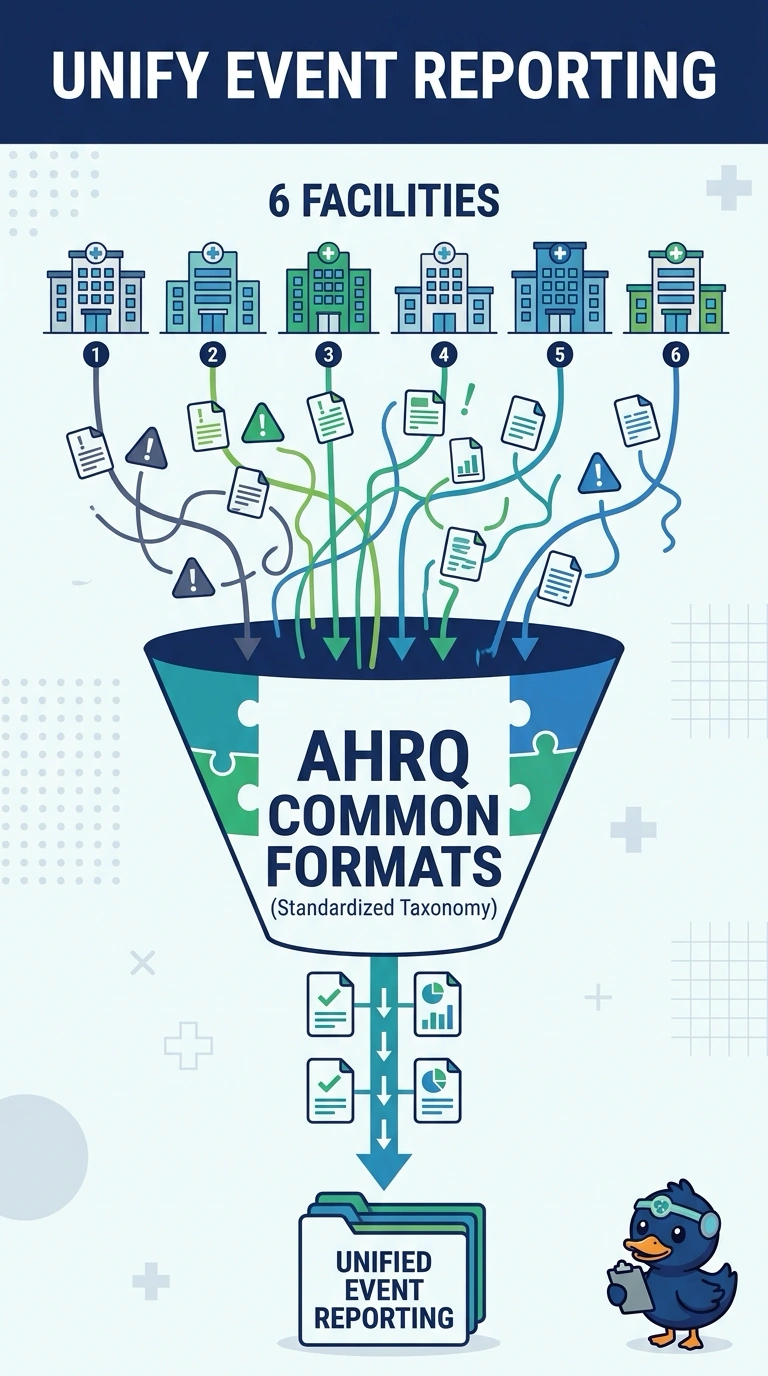
A multi-hospital health system wants to compare near-miss medication and fall trends across six facilities, but each hospital currently uses custom free-text categories in its incident reporting software. What should the patient safety director establish first to enable system-wide learning?
Select an answer to reveal the explanation.
Short Explanation
Comparing safety trends across hospitals without shared definitions is like adding miles and kilometers on the same dashboard. You need a common language for classifying events before system-wide patterns can surface, or your team will misread reporting noise as real clinical risk.
Full Explanation
Establishing A standardized event taxonomy such as AHRQ Common Formats across all facilities creates consistent event types, harm scales, and contributing-factor fields so safety analysts can aggregate data reliably across hospitals. Without uniform definitions, one facility may code an intercepted wrong-dose order as a pharmacy delay while another logs it as a prescribing error, masking system-wide vulnerabilities. Relying on A quarterly manual spreadsheet review of every narrative incident summary is labor-intensive, subjective, and too slow to catch emerging hazards in real time. Setting A unit-level quota requiring each nursing shift to submit five safety reports encourages trivial or duplicate entries that distort true risk signals and erode staff trust. Adopting A policy limiting incident reporting to events that cause temporary or permanent harm eliminates near-miss visibility, stripping the system of early warning data before serious harm occurs. As a caveat, even a standardized taxonomy requires a non-punitive reporting culture so staff feel safe submitting accurate details. For an operational check, audit a random sample of coded safety reports across all six hospitals each quarter to verify inter-rater classification consistency.
Prefer to study offline? Printable PDF study book + test engine ($7.50, unofficial). These questions stay free here.