
A community hospital administers the AHRQ Surveys on Patient Safety Culture and receives an overall positive score of 74% across the organization, leading senior leaders to conclude no action is needed. However, the patient safety officer notices wide variation across departments. What should the safety officer do next?
Select an answer to reveal the explanation.
Short Explanation
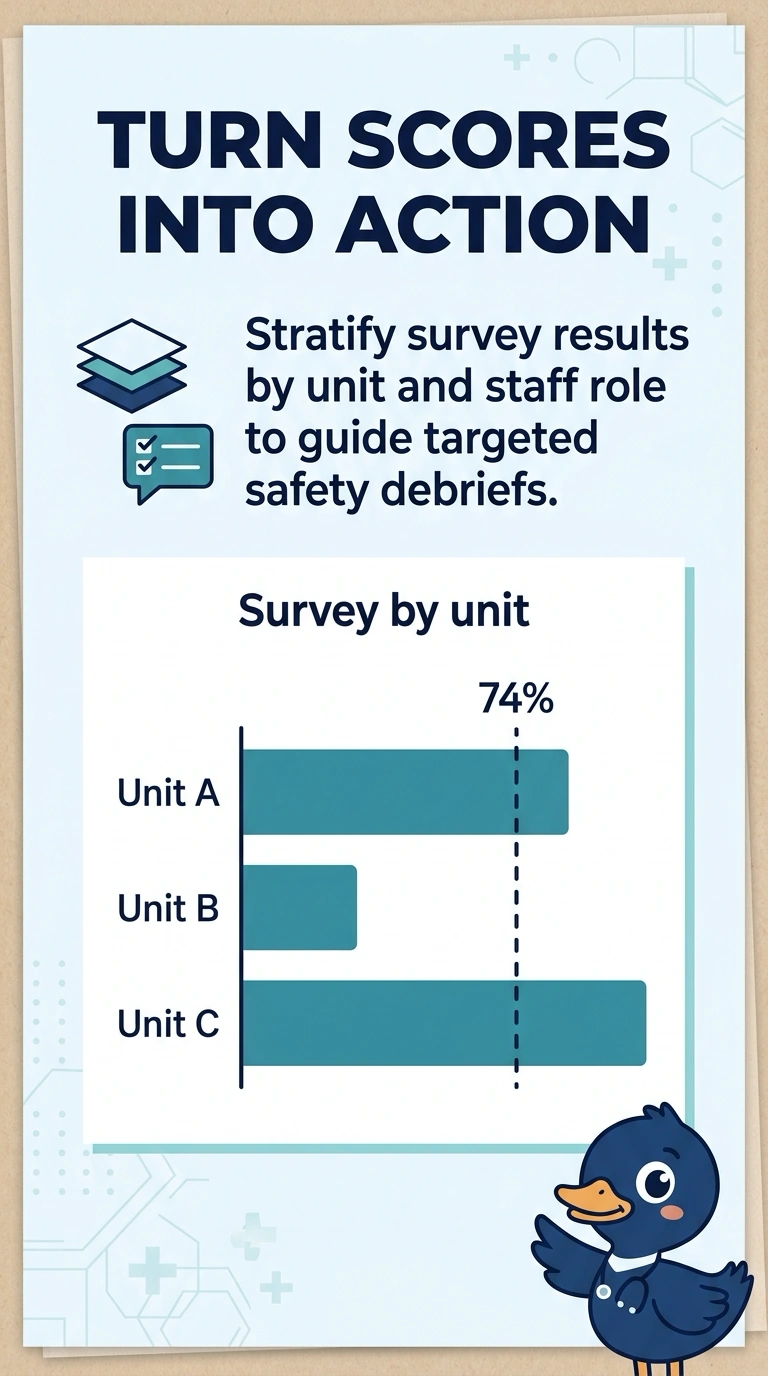
A hospital-wide average can hide a storm in one unit behind sunshine in three others. Before you celebrate a solid overall score, you need to slice the data to see where frontline staff actually feel unsafe speaking up. The trap is letting a healthy composite number lull leadership into inaction.
Full Explanation
Safety culture is inherently local, shaped by unit leadership, workload, and team dynamics. When you stratify survey results by unit and staff role to guide targeted safety debriefs, you uncover pockets of low psychological safety, communication breakdown, or staffing strain that an aggregate score of 74% conceals. Choosing to repeat the full hospital-wide safety culture survey in six months to confirm stability wastes time and risks survey fatigue while known departmental gaps go unaddressed. Choosing to compare the hospital's overall 74% composite score against national registry benchmarks may offer external context, but it still masks internal disparities between high-performing and struggling units. Choosing to require all clinical staff to complete an online module on non-punitive event reporting applies a generic educational fix to every department rather than addressing specific local workflow or leadership barriers. As a caveat, protect respondent confidentiality by suppressing subgroup reports when unit or role cell sizes are too small to preserve anonymity. Operationally, conduct structured unit-level debriefs with frontline staff in the lowest-scoring areas to co-design concrete action plans.
Prefer to study offline? Printable PDF study book + test engine ($7.50, unofficial). These questions stay free here.