
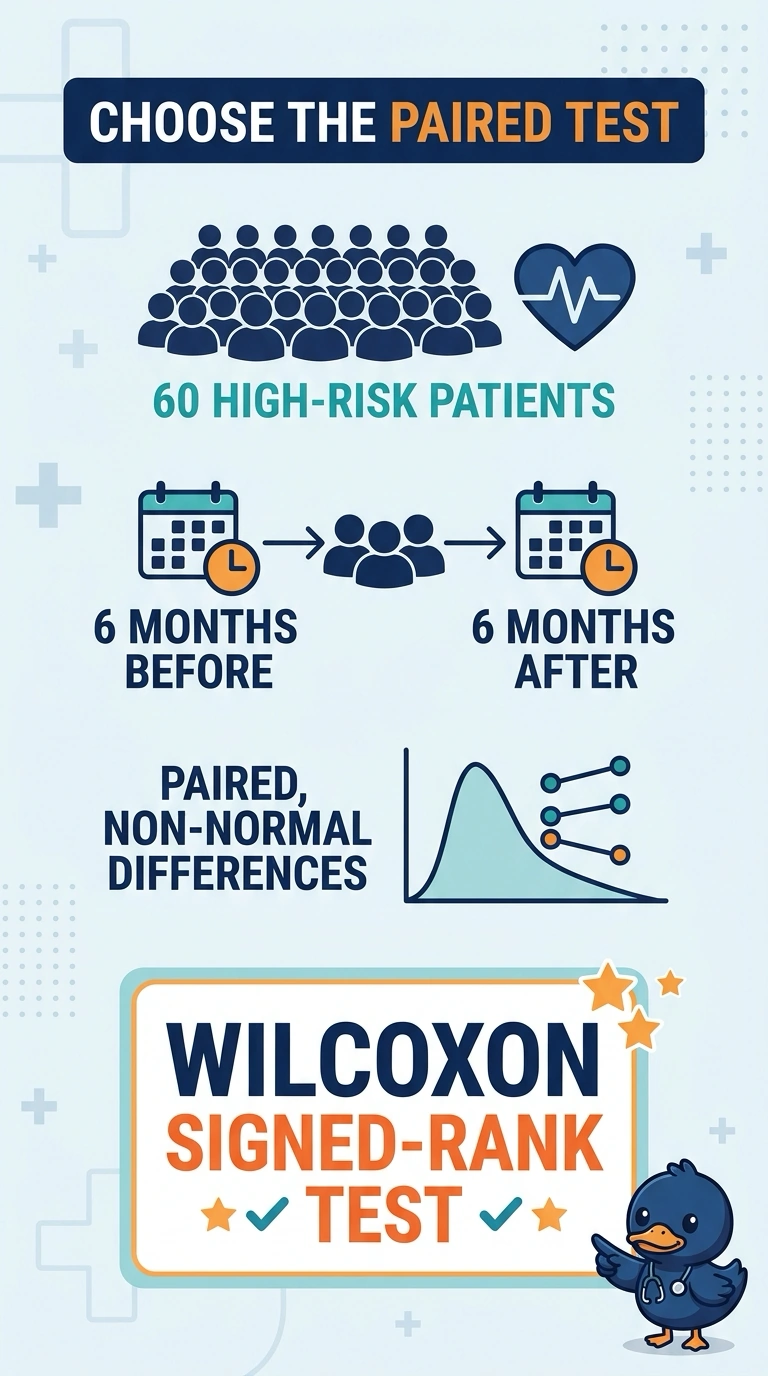
A clinic measures emergency department visit counts for the same 60 high-risk patients during the six months before and six months after enrolling them in a care navigation program. Because the paired differences are not normally distributed, which statistical test is most appropriate?
Select an answer to reveal the explanation.
Short Explanation
When you track the exact same patients before and after an intervention and the counts lean heavily to one side, your choice of test needs to respect both the pairing and the skew. The trap is grabbing a test built for separate groups, multiple clinic sites, or a simple linear trend instead of matched, non-normal data. Use the Wilcoxon signed-rank test so you can evaluate pre-post shifts in the same cohort without assuming a bell-shaped distribution.
Full Explanation
Selecting the right test depends on pairing, scale, and distribution shape. Choosing the Wilcoxon signed-rank test evaluating paired non-normal differences is correct because the same 60 patients are measured before and after enrollment, and ranking signed differences avoids requiring a normal distribution for heavily skewed counts. Using an Independent-samples t-test comparing separate baseline and post-enrollment averages fails because it treats before and after as unrelated groups, discarding within-patient pairing and assuming normality. Applying Pearson product-moment correlation measuring linear association over time fails because it quantifies straight-line association rather than testing a pre-post shift. Running One-way analysis of variance evaluating differences across multiple clinic sites fails because it compares means across independent groups, not two matched periods in one cohort. Wilcoxon signed-rank assumes roughly symmetric paired differences; if that fails, a sign test is the fallback.
Prefer to study offline? Printable PDF study book + test engine ($7.50, unofficial). These questions stay free here.