
A quality analyst at an outpatient clinic network wants to measure the strength and direction of the association between patient-reported communication scores on a 1-to-5 ordinal scale and heavily right-skewed clinic wait times in minutes. Which statistical method is most appropriate?
Select an answer to reveal the explanation.
Short Explanation
Wait times and 1-to-5 satisfaction scores rarely play by normal-distribution rules, so you need a test built for ranked and skewed data. The trap is reaching for Pearson correlation out of habit, which assumes linear, normally distributed continuous variables. When you see ordinal ratings paired with heavy skew, rank-based correlation keeps your analysis honest.
Full Explanation
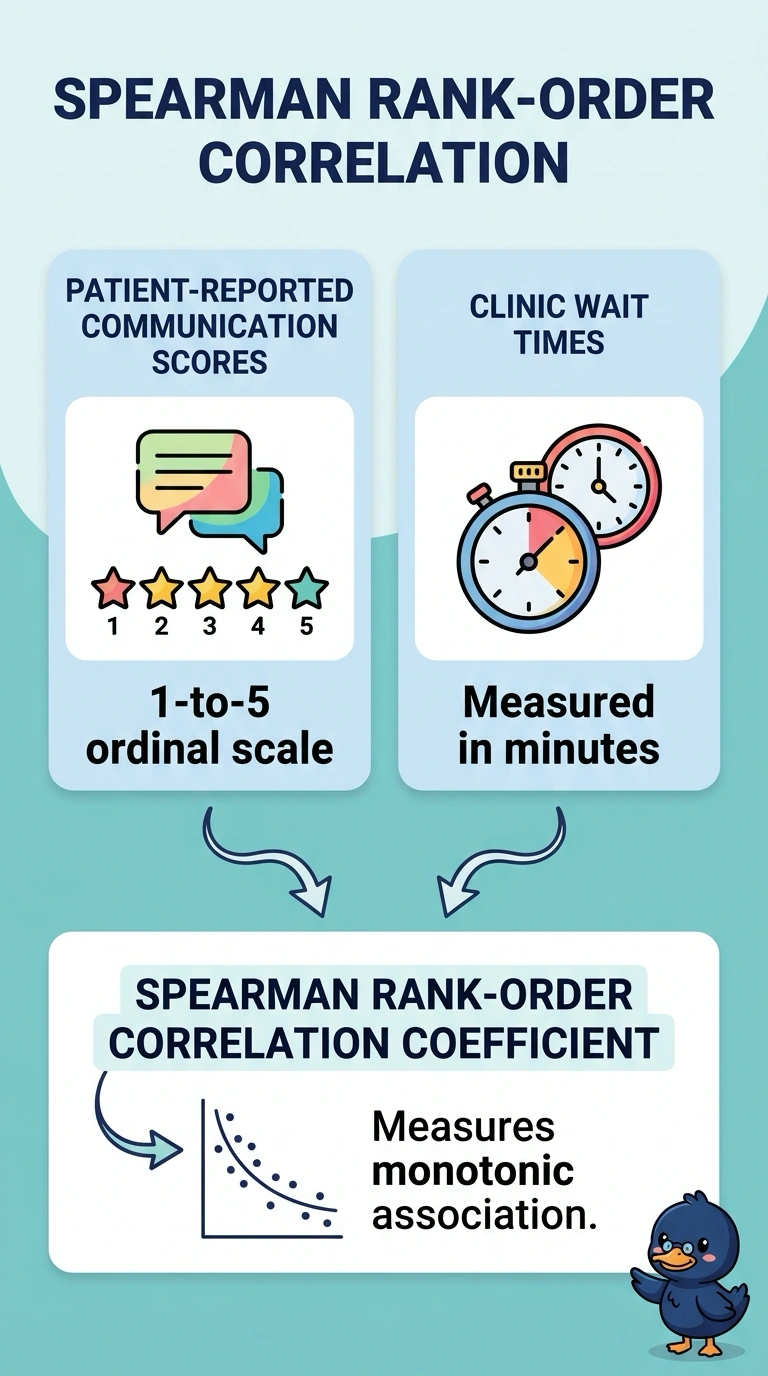
Spearman rank-order correlation coefficient for monotonic association is the right choice because it converts both variables into ranks and measures whether higher values of one variable consistently correspond to higher or lower values of the other without assuming normality or a straight-line relationship. That makes it ideal when pairing a 1-to-5 ordinal communication rating with heavily right-skewed wait times. Pearson product-moment correlation coefficient is sensitive to extreme wait-time outliers and assumes interval-level linearity and bivariate normality, which ordinal scores violate. Independent-samples t-test on mean wait times compares the average of one continuous variable across two separate groups rather than testing the association between two paired variables, and means are distorted by right skew. Chi-square test of independence across clinics tests whether categorical counts differ across groups, discarding the natural ordering of the 1-to-5 scale and wait-time magnitudes. As an exam caveat, remember that a strong rank correlation still does not prove wait times caused lower communication scores, because confounding factors like clinic crowding may drive both. As an operational check, plot the paired observations on a scatter diagram before calculating the coefficient to verify a monotonic pattern and inspect any extreme outliers.
Prefer to study offline? Printable PDF study book + test engine ($7.50, unofficial). These questions stay free here.