
A high-desert 10-kW array with white gravel logs midday power 8% above model on a cold, clear, windy day with puffy clouds, even though the sun angle is low. The tech sees brief spikes as clouds pass and snow glare from nearby drifts. Which factor set best explains these production gains?
Select an answer to reveal the explanation.
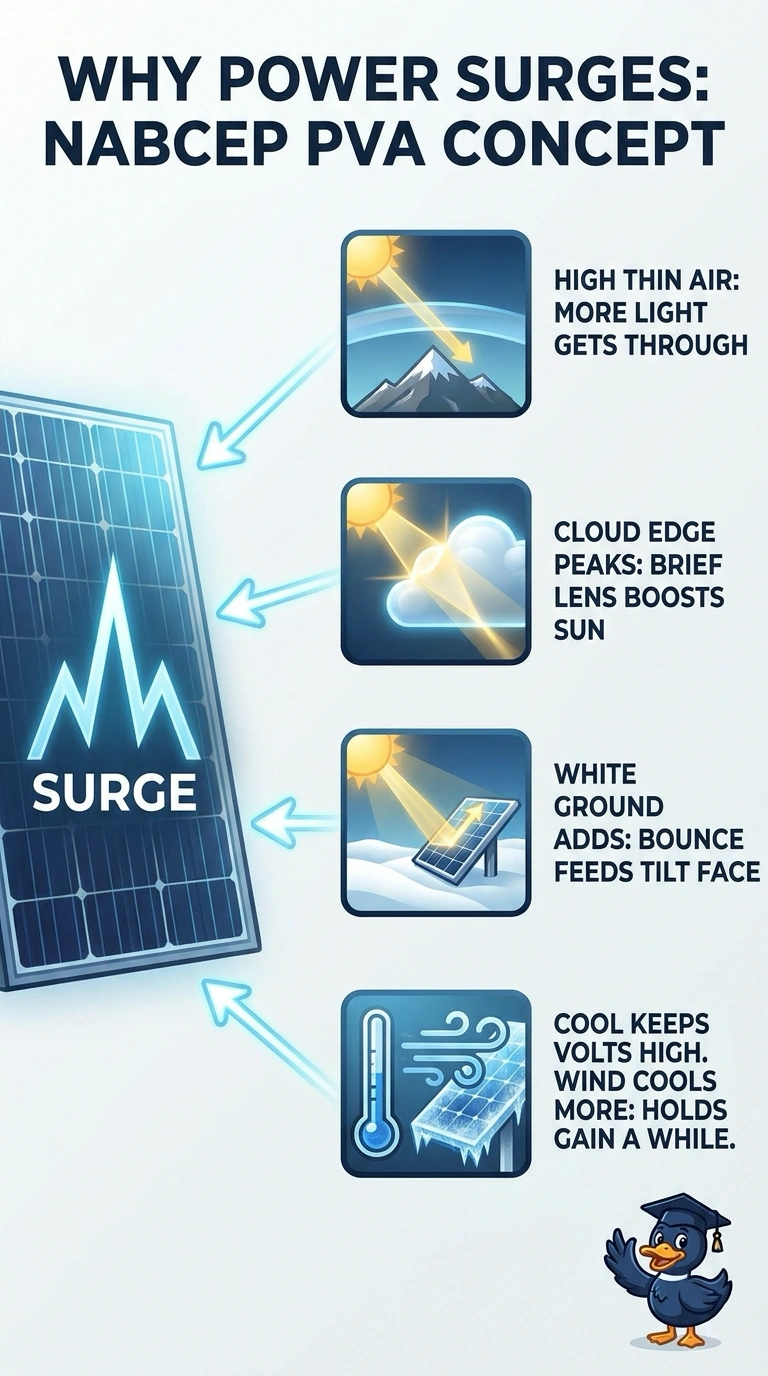
Short Explanation
You can see brief gains when cool cells, bright ground, cloud edges, and thin high-altitude air stack together. Cloud-edge spikes are real, not just noise, and the cold, windy conditions help keep cell temperatures down.
Full Explanation
The stated combination accounts for both the elevated midday output and its brief fluctuations. Cold, windy conditions keep module temperatures below the level assumed by many models, improving voltage and power. White gravel and nearby snow reflect additional light onto the array, while cloud edges can temporarily increase irradiance through enhanced forward scattering and reflection. At high altitude, the thinner atmosphere attenuates less sunlight than the model may assume, partly offsetting the low solar angle. Cooling, bright-ground reflection, and altitude alone do not explain the passing-cloud spikes; cloud-edge enhancement is a recognized cause of short irradiance surges, so treating them as noise misses part of the observation. Cooling, cloud-edge enhancement, and altitude account for the spikes but discount reflection from gravel and snow, omitting a meaningful source of additional plane-of-array irradiance. Bright-ground reflection, cloud-edge enhancement, and altitude account for the light gains but assume wind adds no cooling; wind can increase convective heat loss from modules, so this misses the temperature-related gain under the stated cold, windy conditions. Exam caveat: cloud-edge enhancement is brief and variable, not a dependable basis for expected annual energy yield. Practical check: compare time-synchronized plane-of-array irradiance and module-temperature readings with the model inputs, and verify the irradiance sensor is clean and correctly oriented.