
You lay out a 100-kW flat-roof design requiring fall protection, safe ladder use, and arc-flash labeling with crew training records. The owner asks which workplace safety standards govern each duty versus electrical installation rules. Which reference correctly identifies OSHA, ANSI, and NFPA workplace safety roles?
Select an answer to reveal the explanation.
Short Explanation
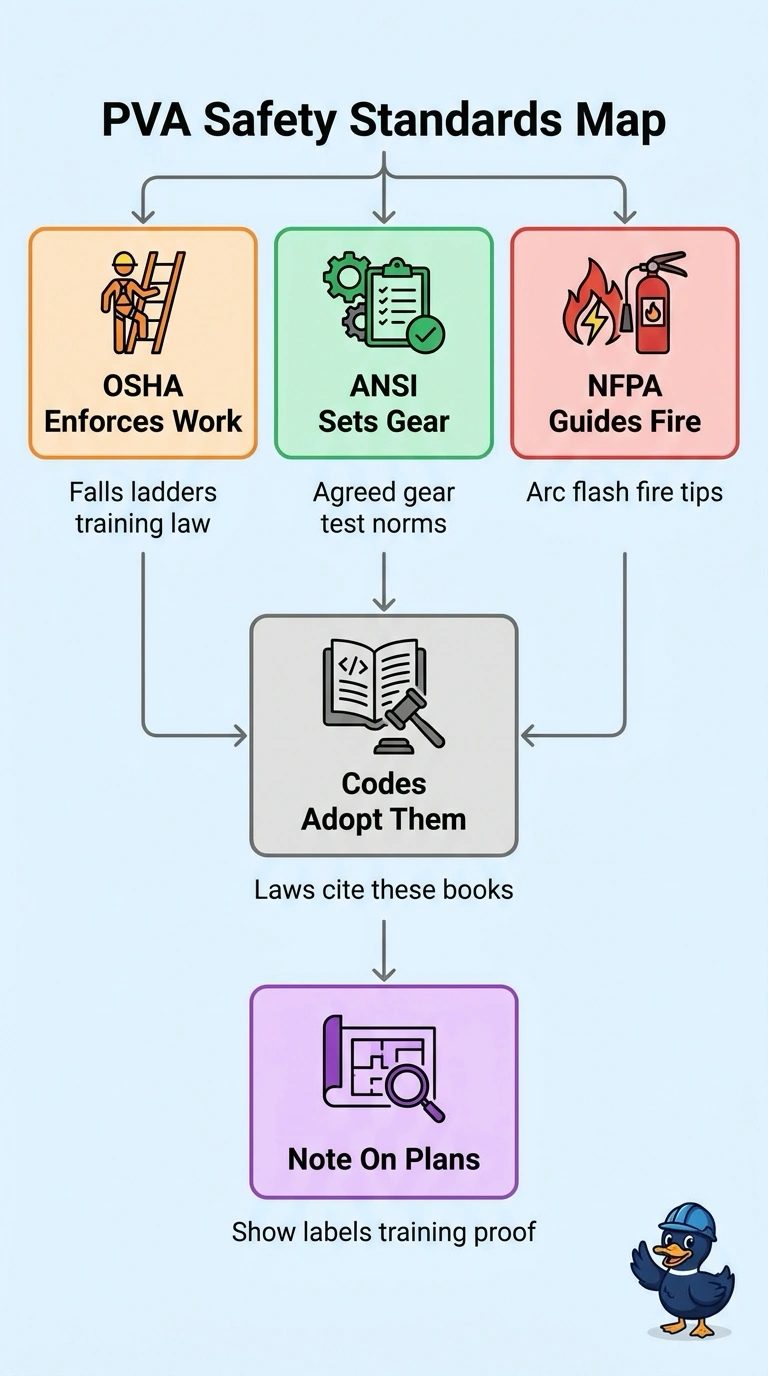
You’re sorting out who protects workers, who develops equipment standards, and who provides fire-electrical guidance. OSHA enforces the workplace rules that can apply to your fall protection, ladder use, and training.
Full Explanation
The correct reference separates three roles: OSHA establishes and enforces federal workplace-safety requirements, including applicable fall-protection, ladder-safety, and training duties; ANSI develops voluntary consensus standards that can inform equipment design and safe practices; and NFPA publishes fire and electrical safety guidance, including codes and standards relevant to electrical hazards. Assigning equipment consensus to NFPA and fire-electrical guidance to ANSI reverses the roles in this framework: NFPA is not the equipment-consensus body here, and ANSI is not the source of the fire-electrical guidance. Treating NFPA installation-code rules as the workplace-safety requirements makes a category error. Electrical installation rules and workplace safety duties can overlap, but they are not interchangeable. Assigning worker-safety enforcement to ANSI and equipment consensus to OSHA also reverses their roles: ANSI does not enforce federal worker protections, and OSHA is not the consensus equipment standards organization. Exam caveat: a consensus standard may become enforceable when incorporated into a regulation, contract, or other applicable requirement, so “voluntary” does not mean irrelevant. Practical check: verify current OSHA requirements for the specific work, then separately check the adopted electrical code and applicable NFPA and ANSI references; confirm which editions and local amendments apply.