
A helper is kitting parts for a 20-kW rooftop to inverter run and asks which items count as balance-of-system beyond modules and inverter. The run needs a main tie-in, service isolation, raceway, wiring, and fault protection. Which balance-of-system grouping should the lead identify for panelboards, disconnects, conduit, conductors, and overcurrent devices?
Select an answer to reveal the explanation.
Short Explanation
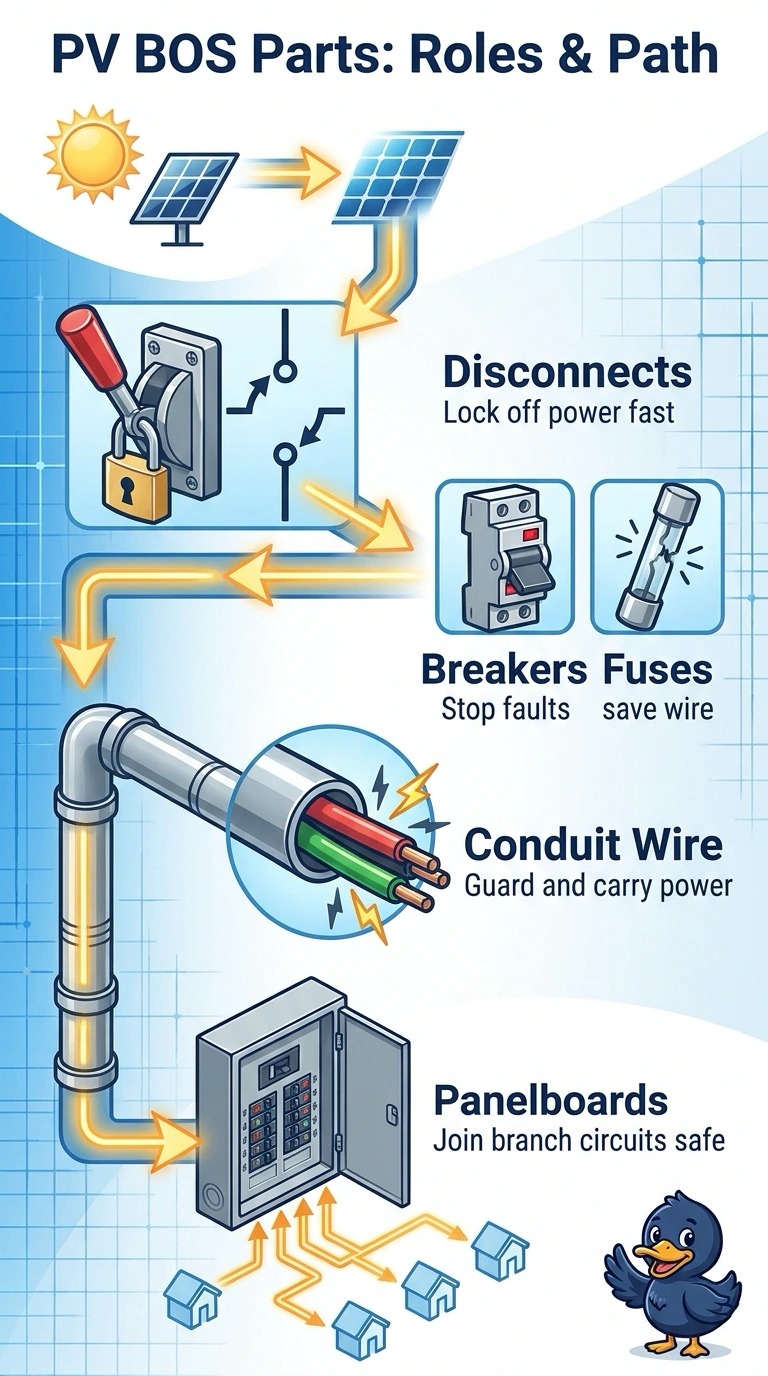
You can sort the balance-of-system parts like a road crew: panelboards tie circuits in, disconnects isolate service, conduit and conductors route power, and breakers or fuses protect against faults. You’ll see each item has a clear job beyond the modules and inverter.
Full Explanation
The correct grouping matches each item to its role in the rooftop run: panelboards provide a point for circuit tie-in, disconnects enable isolation, conduit and conductors route power, and breakers or fuses provide overcurrent protection against faults. A grouping that assigns conductors to equipment bonding recognizes a real function of equipment-grounding conductors, but fails to identify conductors as the power-carrying wiring needed to route energy. A grouping that assigns disconnects to routine load switching reflects a familiar use of switches, but routine switching does not replace the required service isolation; the disconnect must be suitable and located to meet the applicable requirement. A grouping that assigns fault protection to panelboards and branch switching to breakers or fuses gets the tie-in and power-routing roles right, but reverses the protection and switching roles: a panelboard can house protective devices, while breakers and fuses interrupt fault current rather than serving merely as branch switches. Exam caveat: equipment functions can overlap—a breaker may also provide a means of disconnection—so distinguish its overcurrent rating and listing from the installation’s required isolation function. Practical check: verify the one-line diagram, device ratings, and applicable code requirements for service-disconnect location, conductor ampacity, and overcurrent protection.