
A new hire is confused when the foreman cites OSHA for fall protection, ANSI for harness testing, and NFPA 70E for arc-flash practice on the same commercial rooftop job. The manager wants clear roles. Which workplace safety standard distinction should the trainer use to identify OSHA, ANSI, and NFPA responsibilities?
Select an answer to reveal the explanation.
Short Explanation
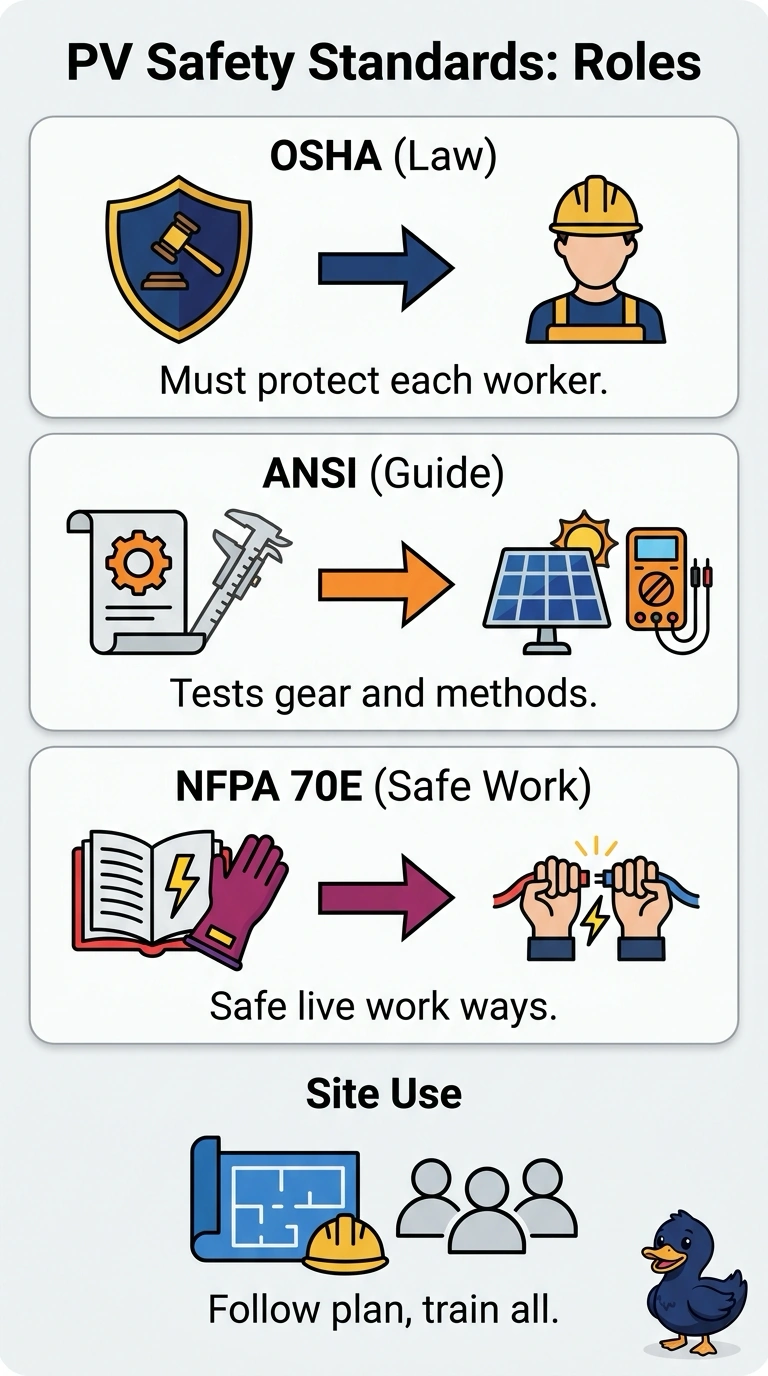
You can keep the roles straight by thinking of OSHA as the enforcer, ANSI as a source of consensus guidance, and NFPA 70E as an electrical safe-work playbook. Roles matter: NFPA 70E guides safe work, not electrical installation.
Full Explanation
The useful distinction separates a regulator from consensus standards and an electrical safe-work standard. OSHA issues and enforces workplace safety requirements, and employers must comply with applicable OSHA rules. ANSI coordinates and accredits the development of voluntary consensus standards, including guidance for product design, testing, and work procedures. NFPA 70E addresses electrical safety in the workplace, including practices that reduce shock and arc-flash risks; it is not the electrical installation code. Describing NFPA 70E as an installation code confuses it with NFPA 70, the National Electrical Code. Treating ANSI guidance as inherently federally enforceable also misstates ANSI’s role: a consensus standard may be adopted or referenced by a regulation or contract, but ANSI does not make every standard federal law. Calling OSHA a source of consensus workplace guidance mistakes an enforcement agency for a voluntary standards-development body. Exam caveat: a standard’s legal force can depend on incorporation into a regulation, contract, or other applicable rule, so “voluntary” does not mean irrelevant. Practical check: verify the cited OSHA rule, ANSI standard edition, and NFPA 70E edition against the employer’s adopted procedures and applicable jurisdiction.