
During commissioning of a 10-kW roof with three strings, the inverter shows low power and one MPPT reads near zero volts in full sun. The lead suspects a dead string, crossed leads, or a hot joint in the combiner. Which commissioning test of string voltage, polarity and thermography best isolates the fault?
Select an answer to reveal the explanation.
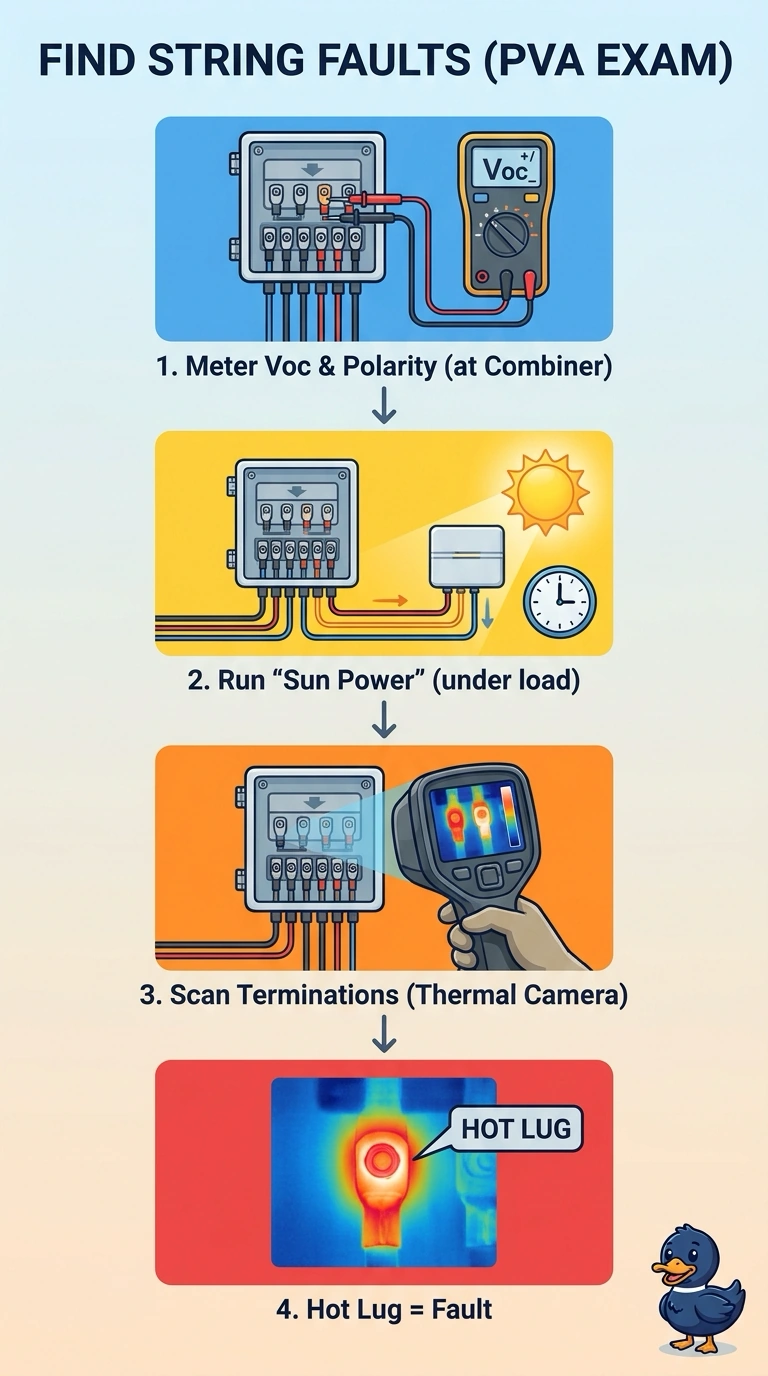
Short Explanation
You start with string voltage and polarity, then let heat reveal what a meter can’t. Pairing both checks with a thermal scan under load helps you find a dead string, crossed leads, or a hot joint.
Full Explanation
The test that measures each string’s open-circuit voltage and polarity at the combiner, then scans the terminations with a thermal camera under load, combines checks suited to the suspected faults. Open-circuit voltage can reveal a dead or disconnected string, polarity can expose crossed leads, and a thermal scan under load can identify a resistive or otherwise hot termination. Measuring voltage and polarity and comparing them with design values is a valid commissioning step that can find a missing or reversed string, but it provides no thermal evidence about a hot combiner joint. Thermographically scanning after shutdown removes the operating current that can make a resistive connection heat up, so a cool-looking unloaded termination does not rule out a hot joint in service. Measuring open-circuit voltage and scanning terminations while the array operates can reveal an abnormal string voltage and a connection that heats under load, but without a polarity check it may not reliably distinguish crossed leads from other voltage abnormalities; one stated fault possibility remains insufficiently tested. Exam caveat: measure open-circuit voltage with the string disconnected from the inverter, following the equipment maker’s isolation procedure; an energized operating-voltage reading is not an open-circuit test. Practical check: compare each string’s measured voltage with the expected value for its module count and current irradiance, and confirm the meter leads and test points before recording polarity.