
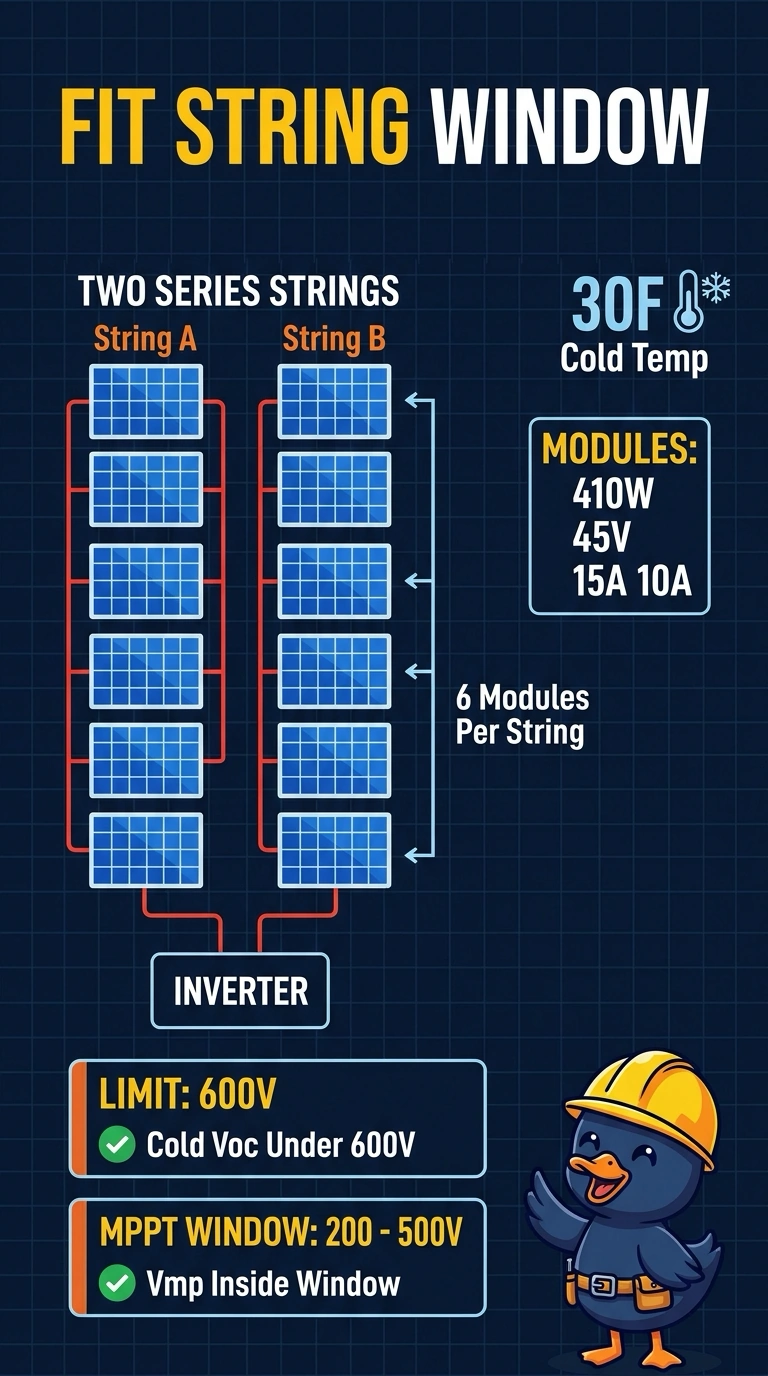
A designer has twelve 410W modules with 45V open-circuit each, a 30F record low, and a string inverter rated 600V max with a 200-500V MPPT window and 15A input limit. Module voltage rises in cold and the 10A short-circuit current fits well. Which string plan stays within inverter limits across seasons?
Select an answer to reveal the explanation.
Short Explanation
You're fitting panel voltage into an inverter window that moves with frost. Six in a row stays under the cold ceiling while landing in the sweet spot, like stacking boxes to clear a low door. Your cold voltage math prevents clipping and shutdowns.
Full Explanation
String voltage adds per module and open-circuit voltage climbs as temperature falls, so the cold-adjusted Voc must remain below the 600V maximum while normal operating Vmp remains inside the 200-500V tracking window. Two strings of six keep nominal Voc near 270V with ample cold margin under 600V and place Vmp comfortably mid-window while current stays under the 15A input. A single twelve-module string doubles Voc to about 540V nominal and cold correction pushes it past 600V, risking inverter damage or startup block. Three strings of four drop Vmp toward or below the 200V MPPT floor on hot days, causing poor tracking and lost harvest despite safe Voc. Paralleling both six-module strings into one input adds no voltage benefit and can exceed input current design intent without need. Exam caveat is to check both cold Voc maximum and hot Vmp minimum. Practical check is to apply temperature coefficients, count series volts, and verify MPPT range and current per input.