
A designer is stringing a 16-module warehouse rooftop array in a hot climate. Each module has a 9.6 A maximum-power current, reaches 43.0 V open-circuit at the coldest design temperature, and falls to 31.0 V at maximum power on a hot roof. The inverter has four MPPT inputs, each with a 15 A maximum operating-current limit and a 600 V maximum voltage, and tracks down to a 160 V floor; all sixteen modules must be installed. Which string layout keeps every module inside the inverter's voltage and current windows at both temperature extremes?
Select an answer to reveal the explanation.
Short Explanation
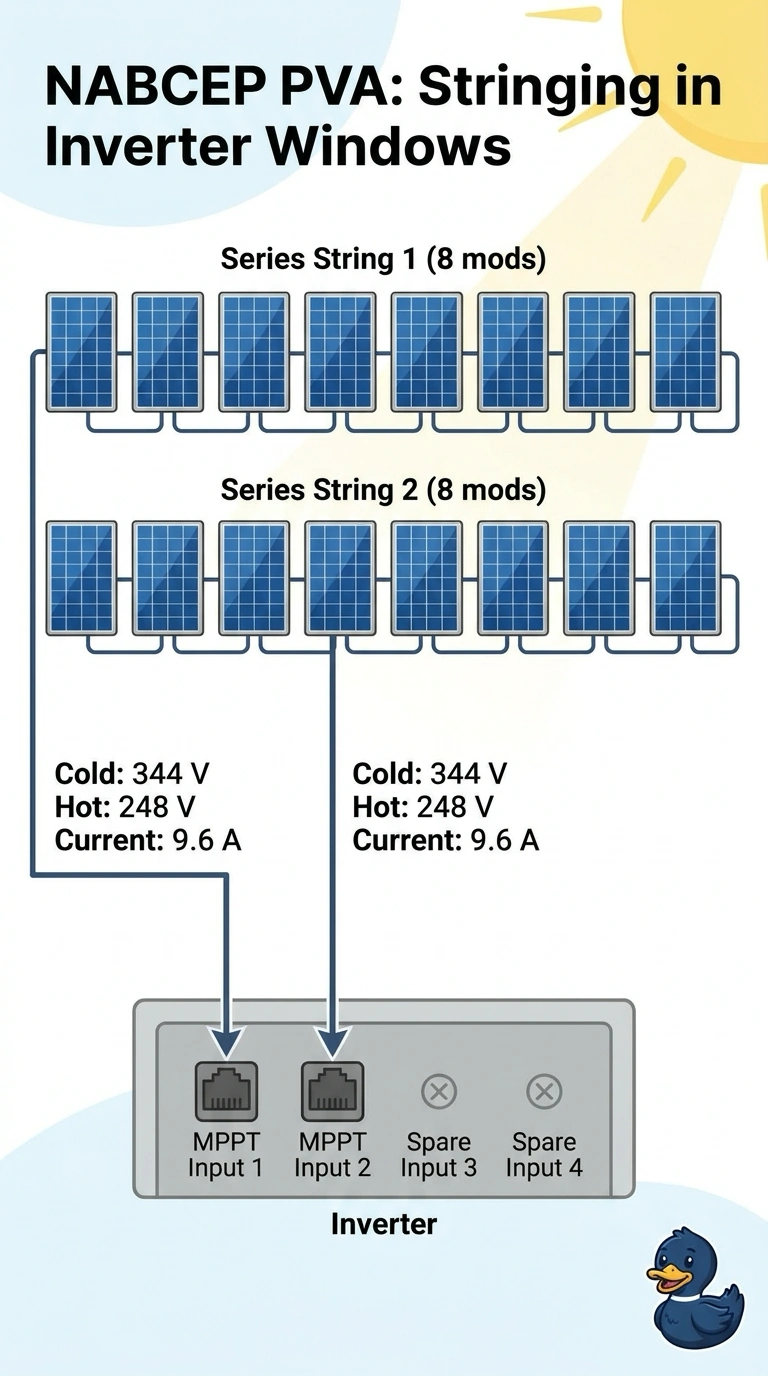
Eight modules in series give you 344 V at the coldest design temperature and 248 V on the hottest roof. One string on each input also holds string current at 9.6 A, below the 15 A limit.
Full Explanation
String design is bounded at both ends of the temperature range, and this layout satisfies both ends at once. At the coldest design temperature each module contributes 43.0 V open-circuit, so eight in series gives 344 V, comfortably under the 600 V ceiling; at peak roof temperature each module falls to 31.0 V at maximum power, so the same string still holds 248 V, well above the 160 V tracking floor. One string per input also keeps input operating current at 9.6 A, below the 15 A per-input limit. Four strings of four modules look tidy and spread the load, but a four-module string produces 124 V at maximum power when the roof is hottest, which is under the floor and leaves the inverter unable to track. A single sixteen-module string clears the floor yet reaches 688 V open-circuit in the cold, past the voltage ceiling. Paralleling two eight-module strings on one input doubles maximum-power current to 19.2 A, exceeding the per-input rating even though the voltages are within the limits. Check worst-case cold open-circuit voltage and hottest maximum-power voltage against the inverter datasheet before ordering wire.