
During a battery retrofit in a garage, the crew finds a swollen lithium cabinet, a cracked lead-acid case with dried acid, plus sharp sheet-metal offcuts and dusty concrete cutting nearby. The schedule is tight and the homeowner is watching. Which handling sequence best controls chemical and physical hazards safely?
Select an answer to reveal the explanation.
Short Explanation
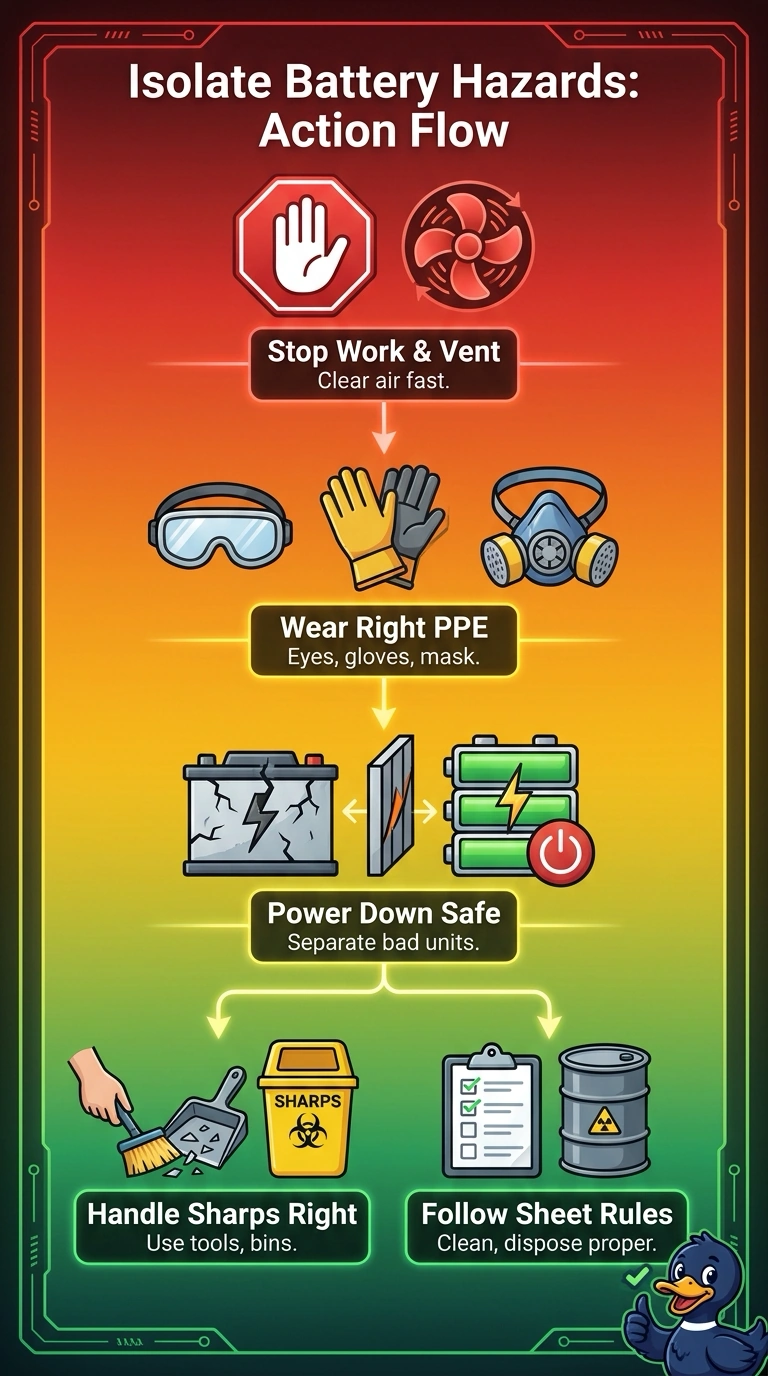
You're right to pause when damaged batteries and sharp debris are present. Ventilation, PPE, isolation, and careful cleanup help you control chemical and physical hazards together; your hazard isolation keeps exposure and injury risks contained.
Full Explanation
The sequence that stops work, ventilates, uses PPE, isolates the damaged batteries, and cleans sharps and dust with proper tools addresses the combined hazards rather than treating them as routine debris. Stopping work prevents exposure while controls are established; ventilation helps disperse airborne contaminants, while PPE, battery isolation, and suitable tools reduce contact, puncture, and inhalation risks. Stopping work, wearing PPE, isolating batteries, and collecting debris with suitable tools still leaves ventilation out, so airborne dust or possible battery-related emissions may remain uncontrolled. Stopping work, ventilating, wearing PPE, and collecting debris while monitoring damaged batteries does not isolate them; observation alone does not limit access or the consequences of worsening damage. Stopping work, ventilating, isolating batteries, and using suitable cleanup tools omits PPE, leaving workers unprotected during handling and cleanup. An exam caveat is that a swollen or damaged lithium battery may present a changing fire or thermal-runaway hazard, so isolation and response should follow site procedures and specialist guidance, not an improvised cleanup plan. As a practical check, confirm work has stopped, ventilation is suitable, workers have task-appropriate PPE, damaged units are in a designated safe isolation area, and dust and sharp offcuts are collected without dry sweeping or bare-hand contact.