
During a class demo an instructor faults a 48-V battery rack where the grounded conductor and the metal case bonds look identical to students. Which explanation correctly distinguishes system grounding from equipment grounding and bonding for this setup?
Select an answer to reveal the explanation.
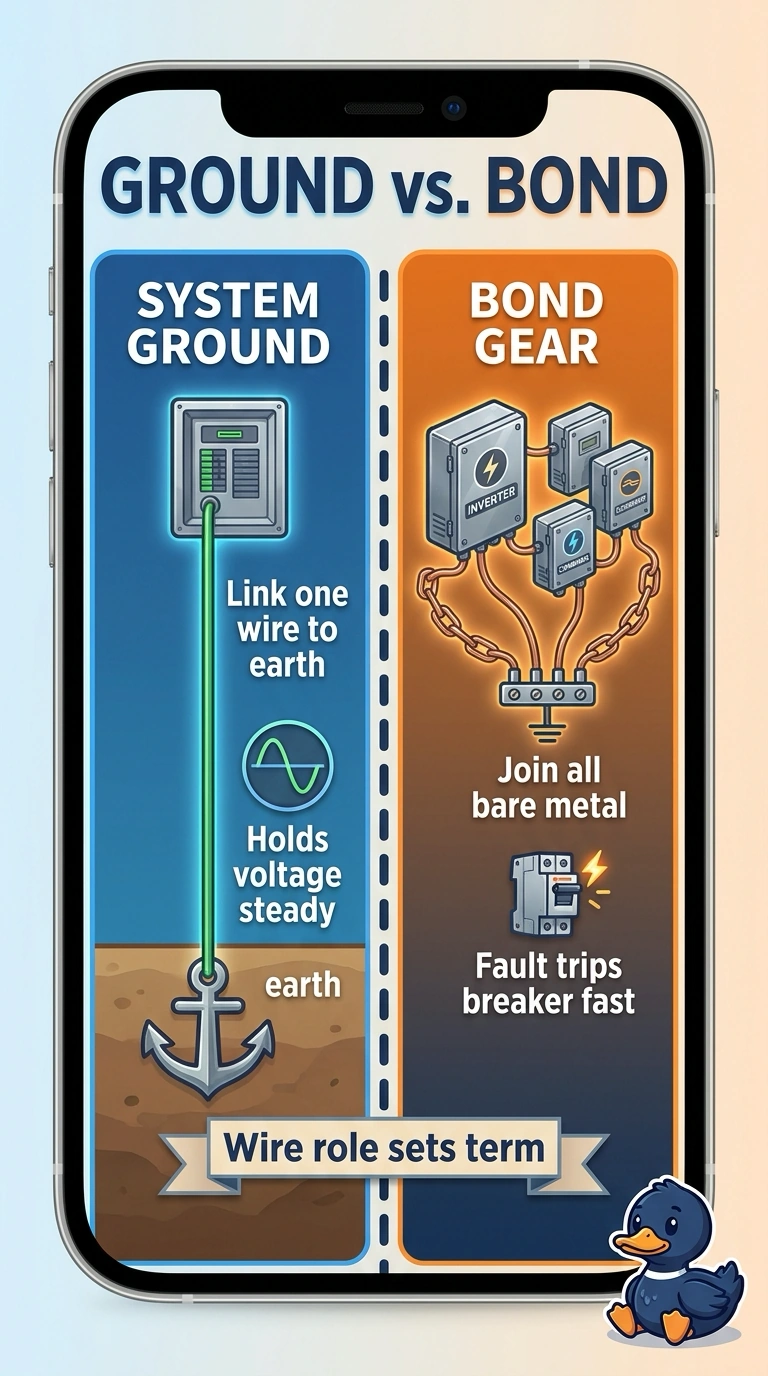
Short Explanation
You can tell the functions apart by their jobs: system grounding connects a circuit conductor to earth, while bonding joins metal cases to ground so fault current can operate protective devices. Think of grounding as an anchor and bonding as a safety route; bonding helps a fault reach protection quickly.
Full Explanation
System grounding intentionally connects a circuit conductor to earth, establishing the system’s earth reference. Equipment grounding and bonding instead join exposed metal cases to the equipment-grounding path, so a fault can return to the source and operate protective devices. Connecting the cases directly to the grounded circuit conductor misidentifies the bonding destination and can create an improper downstream neutral-to-case connection; the cases should use the equipment-grounding path. Connecting the rack cases to earth while tying the battery’s grounded conductor to the equipment-grounding path reverses the roles: cases are not circuit conductors, and their connection belongs to equipment grounding and bonding. Connecting the cases through the grounding electrode also gives them the wrong fault-current route. An electrode provides an earth connection, but soil does not replace the low-impedance metallic path needed to clear a fault promptly. Exam caveat: a 48-V battery system is not automatically grounded at its negative terminal; the design and applicable code determine whether, and where, a circuit conductor is grounded. Practical check: trace the battery’s designated grounded conductor, the rack’s bonding jumper or equipment-grounding conductor, and the permitted connection point; verify continuity and protective-device coordination.