
You explain to a new installer why a small string-inverter home has a grounded DC conductor tied to earth and also green equipment wires bonding frames, rails, and enclosures. The site has lightning exposure and a service grounding electrode. Which explanation correctly distinguishes system versus equipment grounding and bonding?
Select an answer to reveal the explanation.
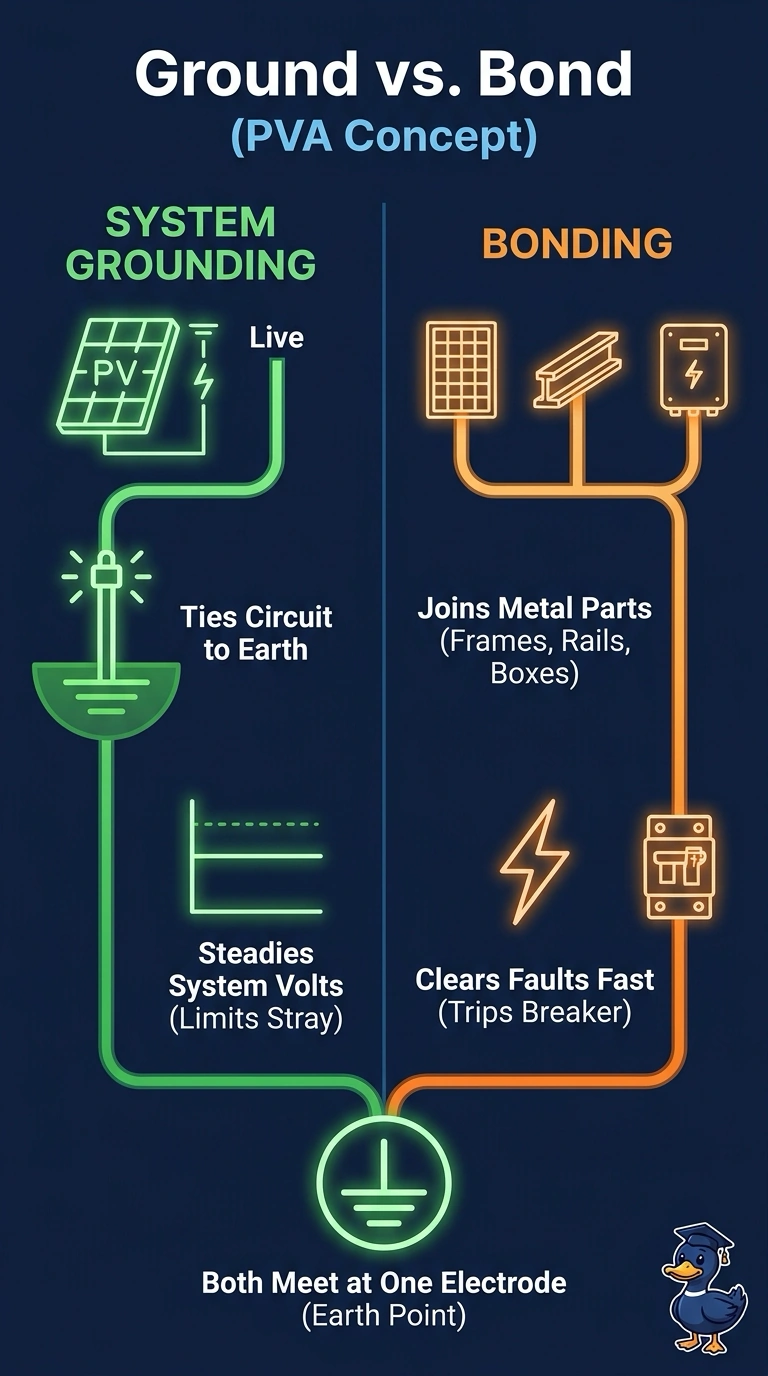
Short Explanation
You’re sorting two green-wire jobs that sound alike, so name each job plainly. Think one anchor, one chain: system grounding references a circuit conductor to earth for stability, while bonding joins metal parts and provides a fault-current path.
Full Explanation
System grounding connects a circuit conductor to earth, establishing a reference that helps stabilize voltage relative to earth. Equipment grounding and bonding join exposed conductive parts, such as frames, rails, and enclosures, so a fault can travel along a low-impedance path and help protective devices operate. The explanation that says bonding carries no fault current gets the metal-joining role right but misses this essential fault-clearing function. The explanation that says equipment grounding remains separate from the service grounding electrode recognizes the earth reference and metal bonding, but incorrectly treats the equipment-grounding arrangement as isolated from the service grounding system; the installation must be coordinated with that system as required by code. The explanation that says bonding handles lightning surges alone also identifies the basic functions, but bonding is not solely a surge measure, nor does it by itself ensure adequate lightning protection; that may require coordinated design and listed protective devices. Exam caveat: grounding and bonding terms and permitted PV configurations can vary by system type and code edition, so do not assume every DC conductor must be grounded. Practical check: consult the inverter documentation and wiring diagram, then verify conductor terminations, bonding continuity, electrode connections, and required overcurrent protection against the adopted code.