
A 50-kW rooftop array in a desert town shows lower midday summer power than its nameplate suggests, but output rebounds on cool windy afternoons despite identical sunlight. The owner suspects soiling only. Which temperature and wind effect explanation should the technician give for performance parameters?
Select an answer to reveal the explanation.
Short Explanation
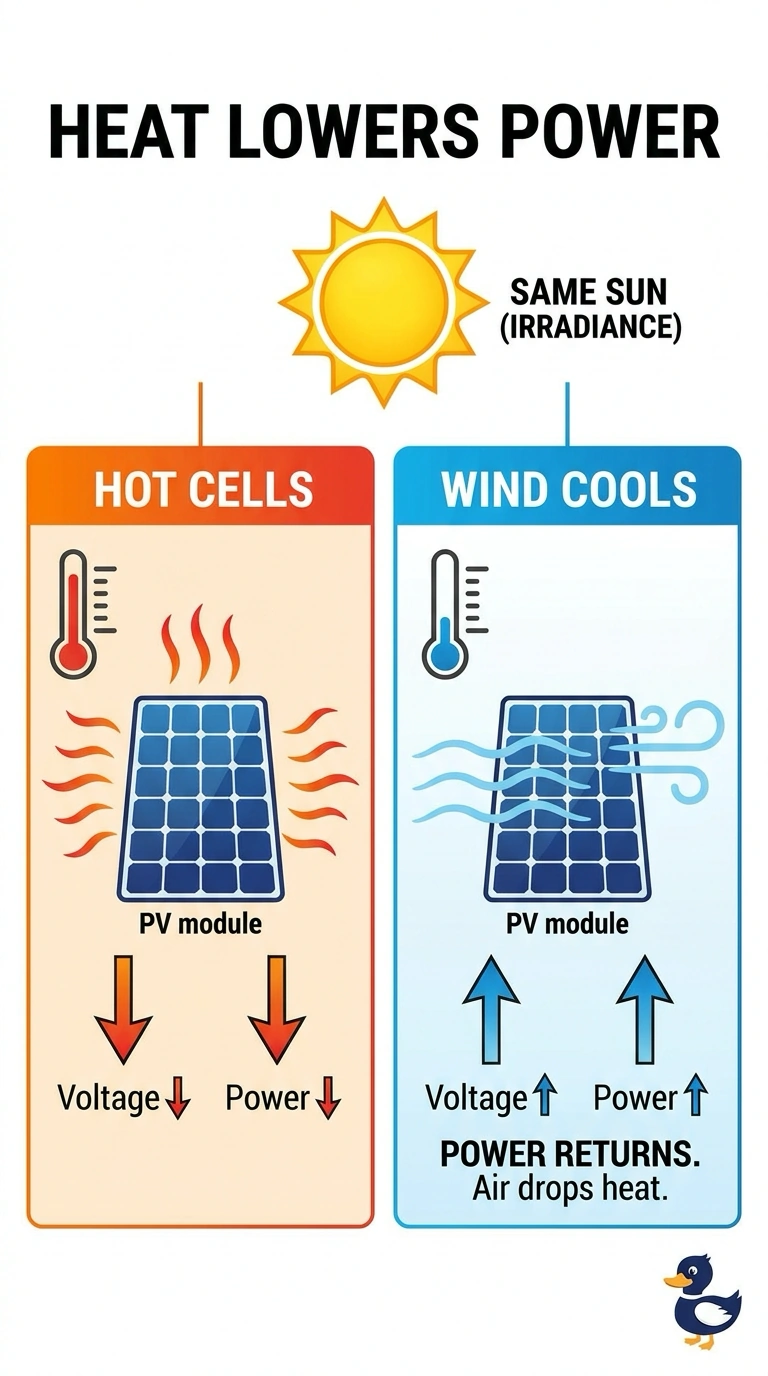
When your panels heat up, cell voltage and power drop; a breeze cools them and helps restore output under the same sunlight. Like your phone working better once it’s out of a hot car, the temperature effect matters—not just soiling.
Full Explanation
The explanation that heat lowers cell voltage and power, while wind cools modules and recovers output at the same irradiance, is correct: higher cell temperature reduces module voltage and therefore maximum power, while wind cooling can raise voltage and recover output. Current is much less temperature-sensitive than voltage, so the explanation that wind restores output mainly by increasing module current is incorrect; a slight current change does not make it the principal mechanism. The explanation that wind cooling lets the inverter avoid thermal derating while module temperature stays unchanged describes a possible system-level effect, but it does not explain the module temperature effect. The explanation that wind restores output by reducing inverter conversion losses rather than cooling modules also identifies a possible source of AC-power loss, but not the module-cooling mechanism at issue. Exam caveat: actual output depends on both DC module behavior and inverter limits, and wind may cool both, so distinguish these effects rather than assuming every recovery is a module effect. Practical check: compare module backsheet or cell-temperature estimates, DC voltage and power, and inverter temperature and AC power at similar irradiance, accounting for shading and soiling.