
A 10 kW rooftop system in Texas shows lower midday power on a 104F calm afternoon than on a breezy 85F morning, though sunlight looks equally bright and no clouds or soiling are found. The owner asks why heat and wind matter. Which explanation best describes temperature and wind effects on output?
Select an answer to reveal the explanation.
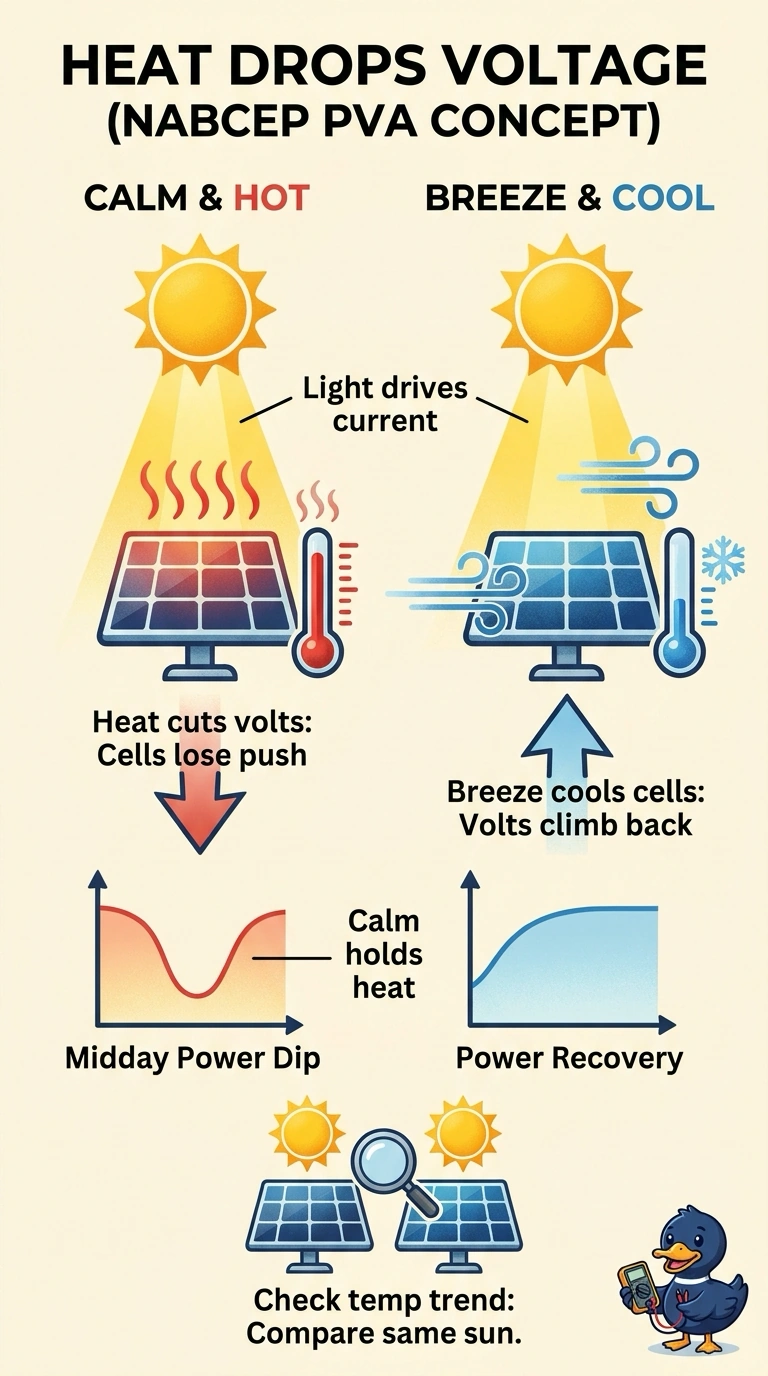
Short Explanation
You're solving a sunny-day mystery where heat quietly steals strength. Warm cells sag in voltage while moving air cools them back up, like a runner slowing in heat but reviving in breeze. Your temperature coefficient explains the midday dip.
Full Explanation
Crystalline cell voltage falls as cell temperature rises, so equal irradiance yields less power on a hot calm roof, and wind improves convective cooling which lowers cell temperature and restores voltage and power. Linking high ambient plus poor airflow to voltage loss and breeze to recovery directly matches the observed midday dip without clouds or dirt. Claiming heat strongly gains current misreads the small positive current effect that never offsets the larger voltage drop, and still air never helps voltage. Blaming windblown dust shading and inverter clipping invents soiling and misplaces heat loss at the inverter rather than the cell. Limiting heat to long-term wiring aging and wind to rack rocking ignores immediate cell physics that drives performance ratio. Exam caveat is that temperature primarily moves voltage while irradiance primarily moves current. Practical check is to compare cell temperature, ambient, wind, and power at similar irradiance to verify the trend.