
An apprentice wires a small grid-tied rooftop system from array to main service and asks what each box and run does. The run uses roof conduit to a fused disconnect, then to the main panelboard with a backfed breaker and an overcurrent device sized for the wire. Which description correctly identifies balance-of-system parts?
Select an answer to reveal the explanation.
Short Explanation
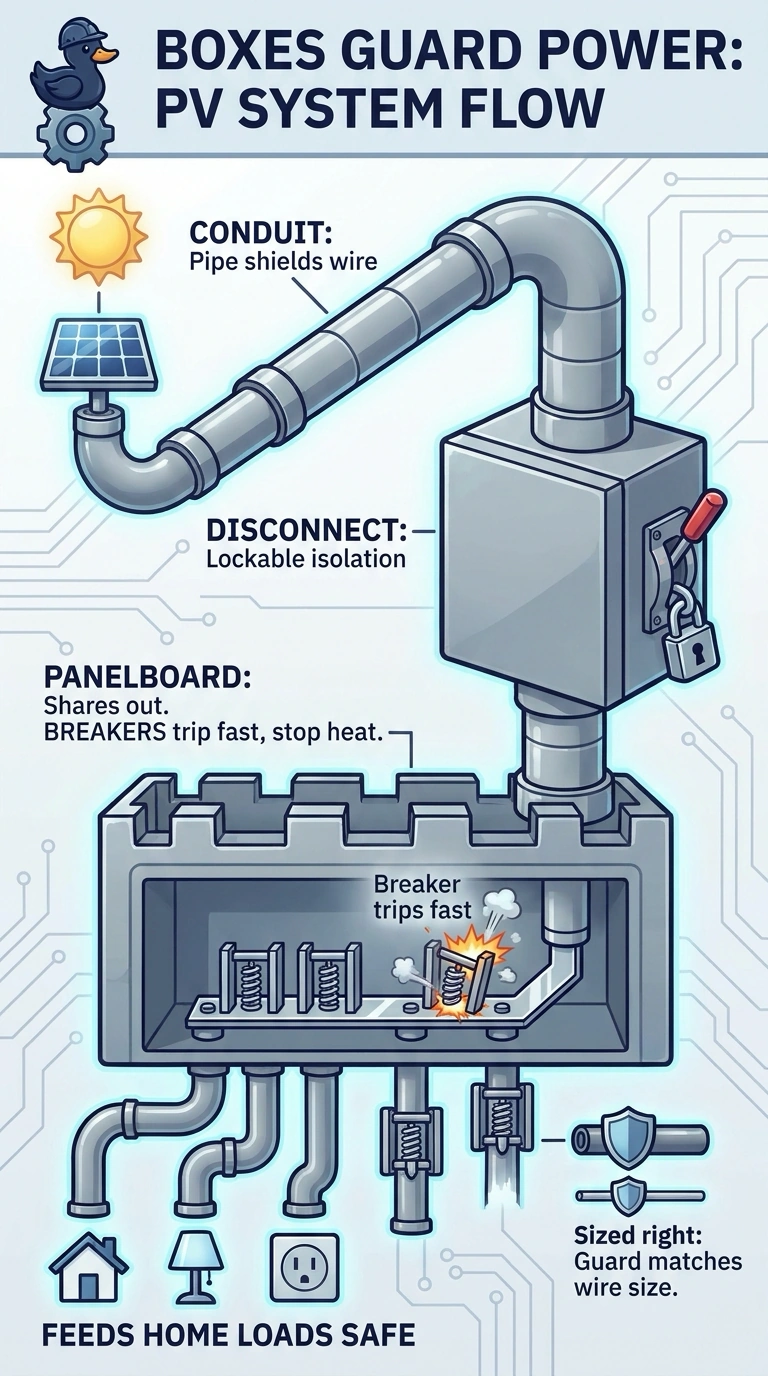
Your balance-of-system parts are safety gear along the power path: conduit protects conductors, the disconnect lets you lock power off, and panel breakers protect the wires and bus from overcurrent. You can think of them as guards that protect the route and let you safely isolate it.
Full Explanation
The correct description assigns each balance-of-system part its function: conduit provides a protective path for conductors, the disconnect allows the circuit to be isolated and locked open for servicing, and the panelboard breakers provide overcurrent protection for conductors while the interconnection is arranged to protect the bus. A disconnect that cannot be locked open may still interrupt the circuit, but it lacks the stated lockable isolation feature needed for secure servicing. A breaker can protect conductors without, by itself, establishing that the panel bus is protected; bus protection also depends on the breaker’s position, ratings, and the applicable panelboard interconnection limits. Selecting the backfed breaker solely from inverter output disregards conductor ampacity, so the overcurrent device may not adequately protect the wire; sizing must satisfy applicable code rules and equipment instructions. Exam caveat: “backfed breaker” describes how the source connects to the panel, not a different protection principle, and bus protection is not established by the breaker label alone. Practical check: verify the disconnect’s lock-open provision, the conductor ampacity and overcurrent-device rating, and the panel’s permitted source-breaker position and bus rating against its labeling.