
An installer is asked to mount flush rails on a 6-year-old architectural shingle roof at 4:12 pitch with one soft spot near a valley, and the owner provides a 25-year shingle warranty that bars non-approved sealants and grinding. The attic shows 24-inch truss spacing. Which mounting assessment best respects roof type, pitch and warranty impact?
Select an answer to reveal the explanation.
Short Explanation
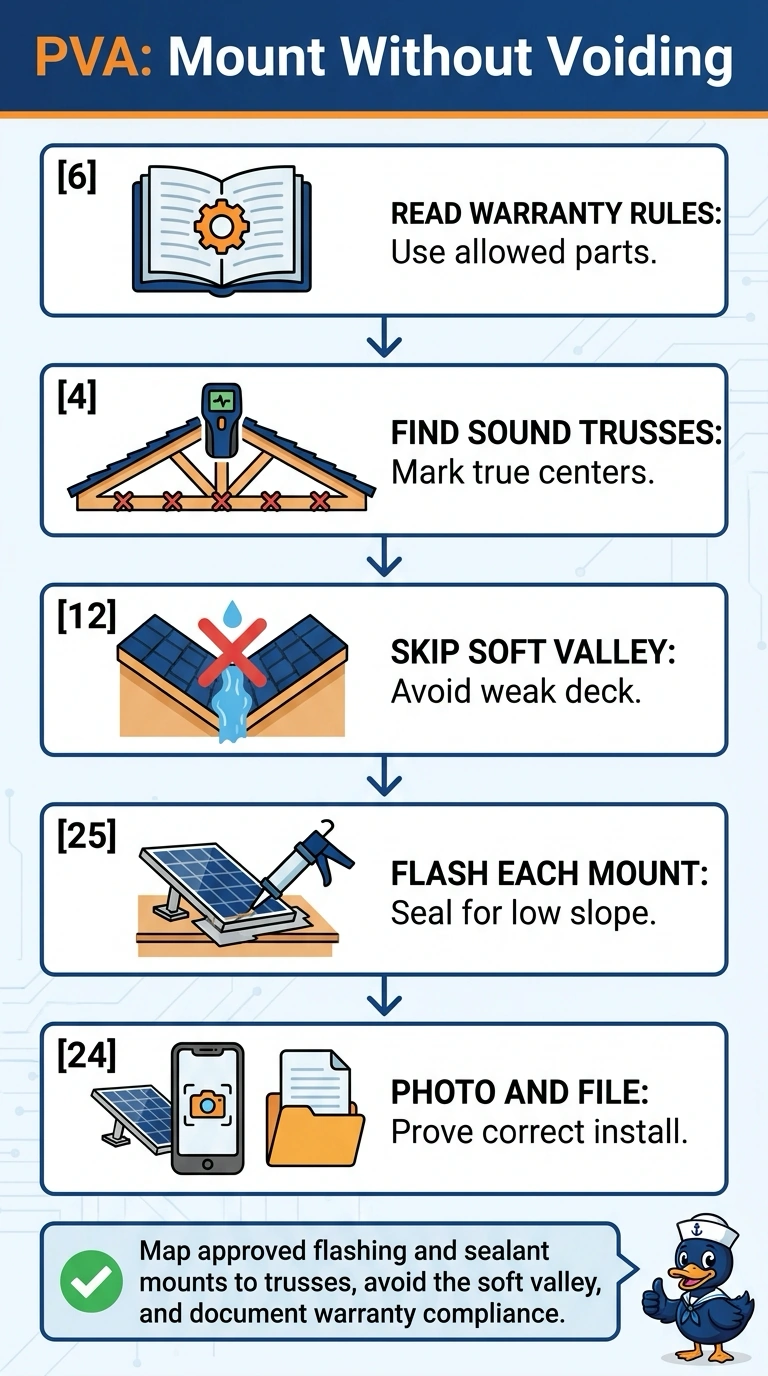
You can protect the roof and its warranty by mapping approved flashing and sealant mounts to the trusses, avoiding the soft spot, and documenting compliance. That gives you a warranty-safe layout suited to the roof and its framing.
Full Explanation
The assessment that maps approved flashing and sealant mounts to the trusses, avoids the soft spot, and documents warranty compliance addresses the roof’s asphalt shingles, 4:12 pitch, 24-inch truss spacing, and warranty restrictions. Approved materials respect the prohibition on non-approved sealants and grinding, while fastening to the trusses provides sound attachment; avoiding the soft area near the valley avoids relying on potentially unsound roof decking. Recording compliance also leaves a record that warranty conditions were considered. An approach using approved flashed mounts at the trusses and avoiding the soft spot, but proceeding without recording warranty compliance, leaves that consideration undocumented. An approach that documents compliance and uses approved flashing mounts at the trusses but places a mount over the soft valley fails to address the known soft area, where the deck may not provide sound support. An approach that avoids the soft spot, documents compliance, and uses approved flashed mounts but specifies a rail kit rated only for 5:12 and steeper is unsuitable for this 4:12 roof. Exam caveat: warranty requirements and slope limits are product-specific; familiar flashing or sealant is not necessarily approved for every shingle warranty. Practical check: verify the exact mount, sealant, and slope rating in current manufacturer documentation, then confirm truss locations and inspect the soft area before laying out penetrations.