
A homeowner is quoted a 8-kW rooftop system with a 25-year module performance promise, a 12-year string inverter warranty, and first-year savings that assume no output change. She plans to stay 20 years and wants true lifetime cost. Which economic assumption correctly accounts for degradation, replacement, and warranty limits?
Select an answer to reveal the explanation.
Short Explanation
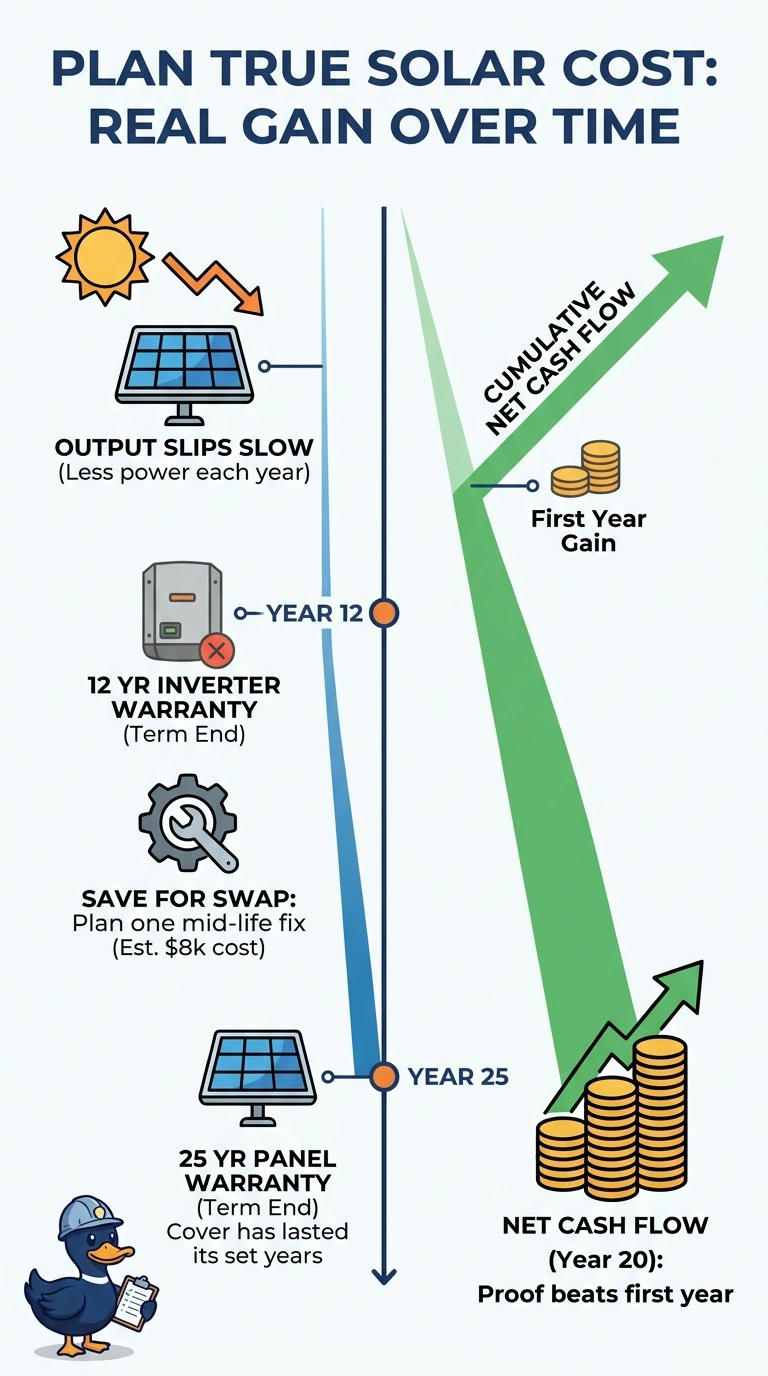
Your lifetime estimate should include degradation—a small yearly drop in output—and budget for one inverter replacement after its 12-year warranty ends, valuing each warranty only as far as its terms allow. It’s like budgeting for a car’s gradual wear and an out-of-warranty repair, so you don’t count promised savings beyond what’s actually covered.
Full Explanation
The correct assumption captures the three distinct drivers of lifetime cost: gradual module degradation reduces the energy available in later years, an inverter may need replacement during a 20-year ownership period after its 12-year warranty expires, and warranty value is limited to the coverage and remedies actually promised. This avoids treating first-year savings as constant and avoids assuming that a warranty is equivalent to a cash guarantee. Holding annual production constant is a common screening simplification, but it misses the stated need to account for degradation; even with an inverter allowance and properly bounded warranty treatment, it will overstate later-year generation. Omitting an inverter-replacement allowance because failure is uncertain also misses a material expected cost: uncertainty is a reason to estimate a replacement probability or reserve, not to set the cost to zero over a long ownership horizon. Crediting the module promise as cash reimbursement for every lost kilowatt-hour confuses a performance warranty with an unconditional payment; coverage may require a threshold shortfall, a claim, and a remedy defined by the contract. Exam caveat: the stated warranty duration alone does not establish the warranty’s degradation guarantee, exclusions, or compensation method. Practical check: compare the quote’s production assumptions with the module warranty terms, local degradation estimates, and an inverter replacement cost and timing estimate.