
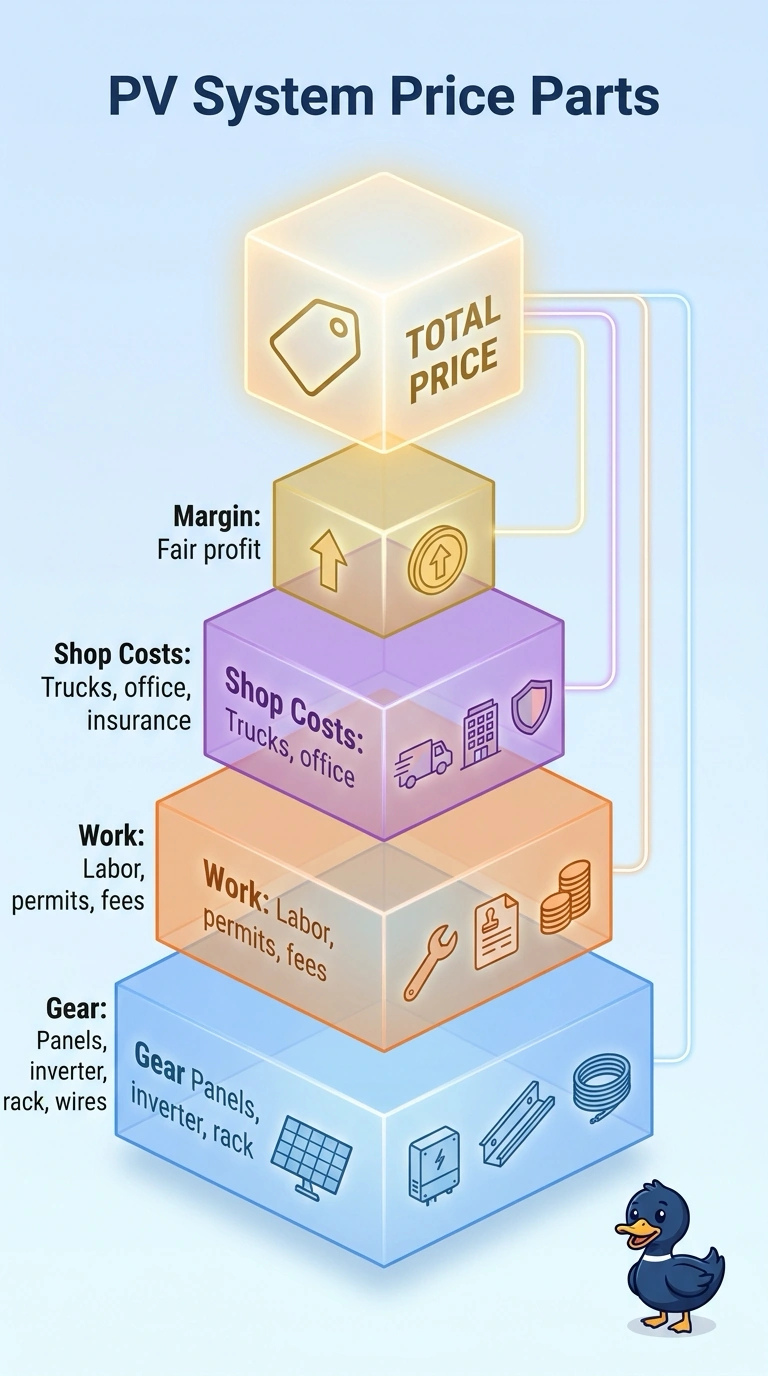
A sales rep must explain a 7-kW home quote to owners comparing two bids with different totals but similar panel counts. The owners ask what actually drives the installed price. Which breakdown correctly identifies system price components for the economics comparison?
Select an answer to reveal the explanation.
Short Explanation
You're opening the whole pie so buyers compare apples to apples. Listing full parts beats sticker shock with clear, honest math.
Full Explanation
The correct breakdown identifies both equipment and project-delivery costs, then distinguishes overhead from margin. That separation helps owners compare bids whose totals may be similar despite different cost structures; panel count alone does not explain those differences. Combining overhead and profit into one allowance is a familiar estimating shortcut, but it conceals two different economic concepts: overhead supports business operations, while margin is the amount retained above costs. Grouping racking into balance of system can be reasonable for a broad internal estimate, yet it fails a comparison that specifically asks for racking as a distinct price part, making differences in mounting scope harder to see. Charging permit fees through an installer's labor line may simplify a turnkey quote, but it obscures a project-specific regulatory cost and prevents a clear like-for-like permitting comparison. Exam caveat: proposals use different labels and may bundle items, so a line-item label alone does not prove that the same scope or cost is included. Practical check: ask both contractors for a scope-matched breakdown showing equipment, labor, permitting, overhead, and margin, and clarify which bundled items are included in each line.