
A homeowner with high evening use and a sunny roof asks why two neighbors with same-size systems have very different bills under different utilities. One has net metering, one has time of use with low midday credit, and a small shop faces demand charges. Which rate-structure interpretation should the associate give for a preliminary system estimate?
Select an answer to reveal the explanation.
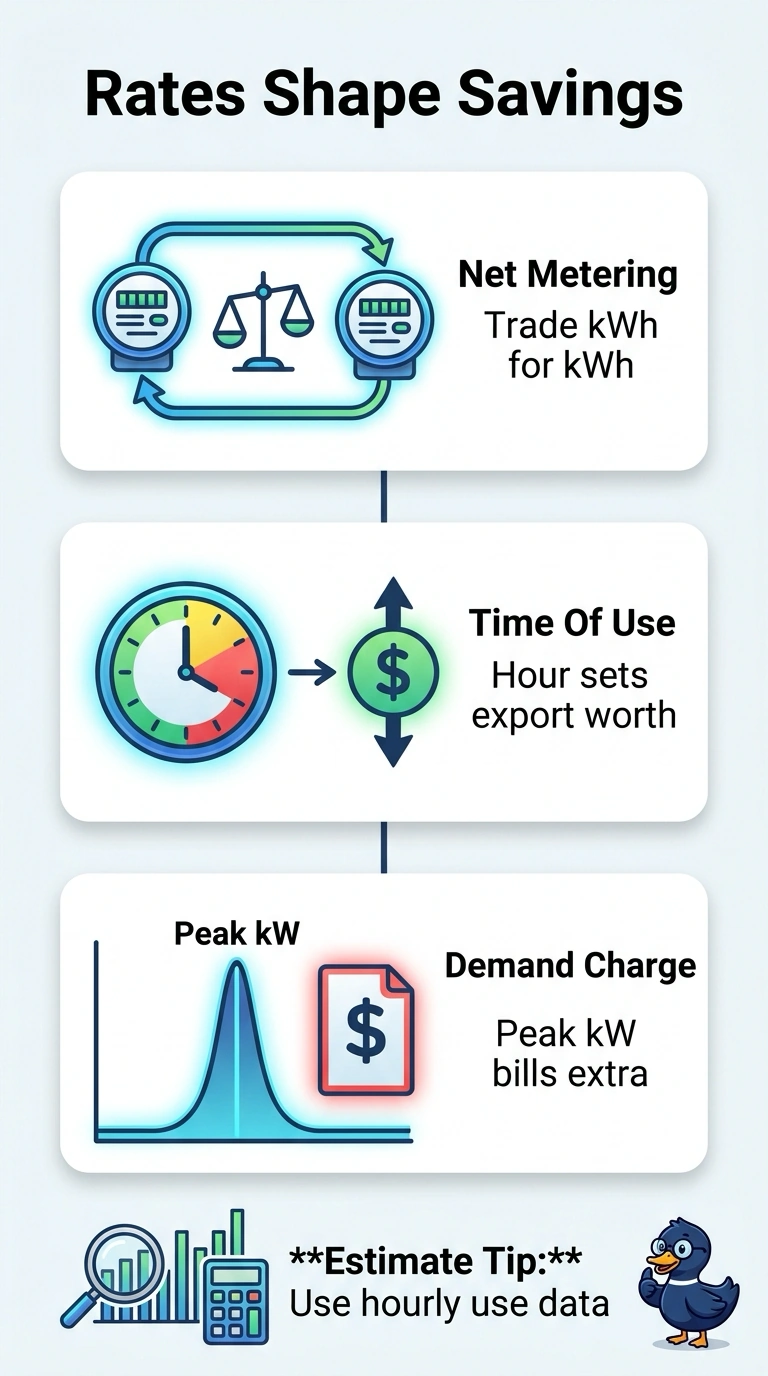
Short Explanation
You can see why similar systems lead to different bills when utilities value solar energy differently. The rate-timing lens is like matinee versus evening movie prices: match when you make power to when it counts most.
Full Explanation
The correct interpretation separates three billing mechanisms that can produce different outcomes even for similarly sized systems. Net metering offsets eligible electricity use in kilowatt-hours under the utility’s rules. Time-of-use export compensation depends on when energy is sent to the grid, so a system producing mostly at midday may receive less credit when midday rates are low. A demand charge is a separate charge tied to peak power use during a defined interval, not simply total monthly energy consumption. An interpretation that says net metering credits exports at retail dollar value may overstate the credit: net metering offsets kilowatt-hours, and export compensation need not equal the retail price. An interpretation that gives time-of-use exports the same credit in every hour misses the stated hourly variation in export value. An interpretation that treats demand charges as a higher per-kilowatt-hour energy rate misses their separate peak-power basis, which can matter for the shop. Exam caveat: tariffs vary, and net metering rules, export credits, demand intervals, and eligibility differ by utility. Practical check: obtain each customer’s current tariff and interval usage data, then model imports, exports, and peak demand under that specific rate.