
A homeowner's hybrid inverter provides backup to part of a 200 A main panel from a fully charged battery with 10 kWh usable capacity, and the budget leaves no room for extra battery capacity. During evening outages the inverter carries the 4.5 kW water heater and 7 kW EV charger without any power limit, yet the battery runs dry in about an hour and the fridge goes dark. The fridge, lights, and router together average 0.5 kW, and outages typically last 10 hours until sunrise. Which load-control change will keep the fridge and other critical loads powered until sunrise?
Select an answer to reveal the explanation.
Short Explanation
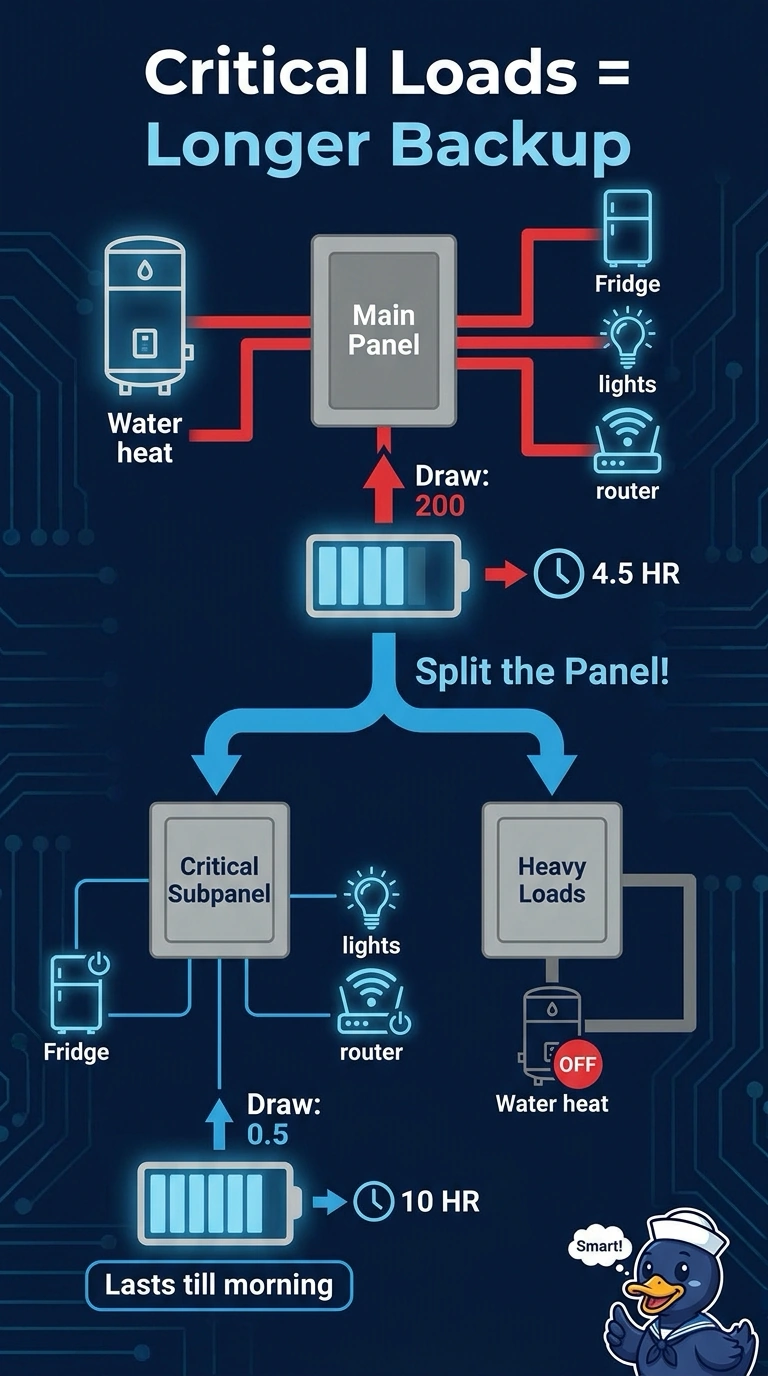
A critical loads subpanel limits battery use to essential loads, whose stated 0.5 kW average draw uses 5 kWh over 10 hours. You're managing stored energy, not inverter power.
Full Explanation
The critical loads average 0.5 kW, so they need about 5 kWh over a 10-hour outage, before allowing for inverter losses and reserve. Moving the fridge, lights, and router to a critical-loads subpanel separates them from the high-demand circuits; with the 10 kWh battery fully charged and those heavy loads excluded, there is adequate stored energy to carry the critical loads until sunrise. Moving the EV charger off backup is sensible, but retaining the 4.5 kW water heater on the backed-up panel leaves a large, thermostat-cycled load competing for the same finite energy; its overnight consumption is not constrained to fit the remaining capacity. State-of-charge-based shedding is also a common strategy, but the full 12 kW load would use the first 5 kWh in about 25 minutes, leaving about 5 kWh for 10 hours at 0.5 kW, which is zero margin before inverter losses or reserve, so it cannot reliably cover the required 10 hours. Capping EV charging at 1.4 kW reduces demand, but the critical loads plus even that capped charger would average 1.9 kW, or about 19 kWh over 10 hours; excluding the water heater does not fix the battery-energy shortfall. Exam caveat: inverter power rating and battery energy capacity are different limits, and adequate instantaneous power does not establish adequate runtime. Practical check: verify the backed-up circuits and inverter load-shed settings, then calculate runtime using measured load energy, usable battery capacity, conversion losses, and any required reserve.