
A crew mounts aluminum rails on a home 500 feet from salt water using stainless L-feet and lag screws into rafters with flashing. Morning dew keeps joints damp for hours and past jobs show white crust and pitting where bare steel touched aluminum. Which fastener practice best ensures strength and metal compatibility?
Select an answer to reveal the explanation.
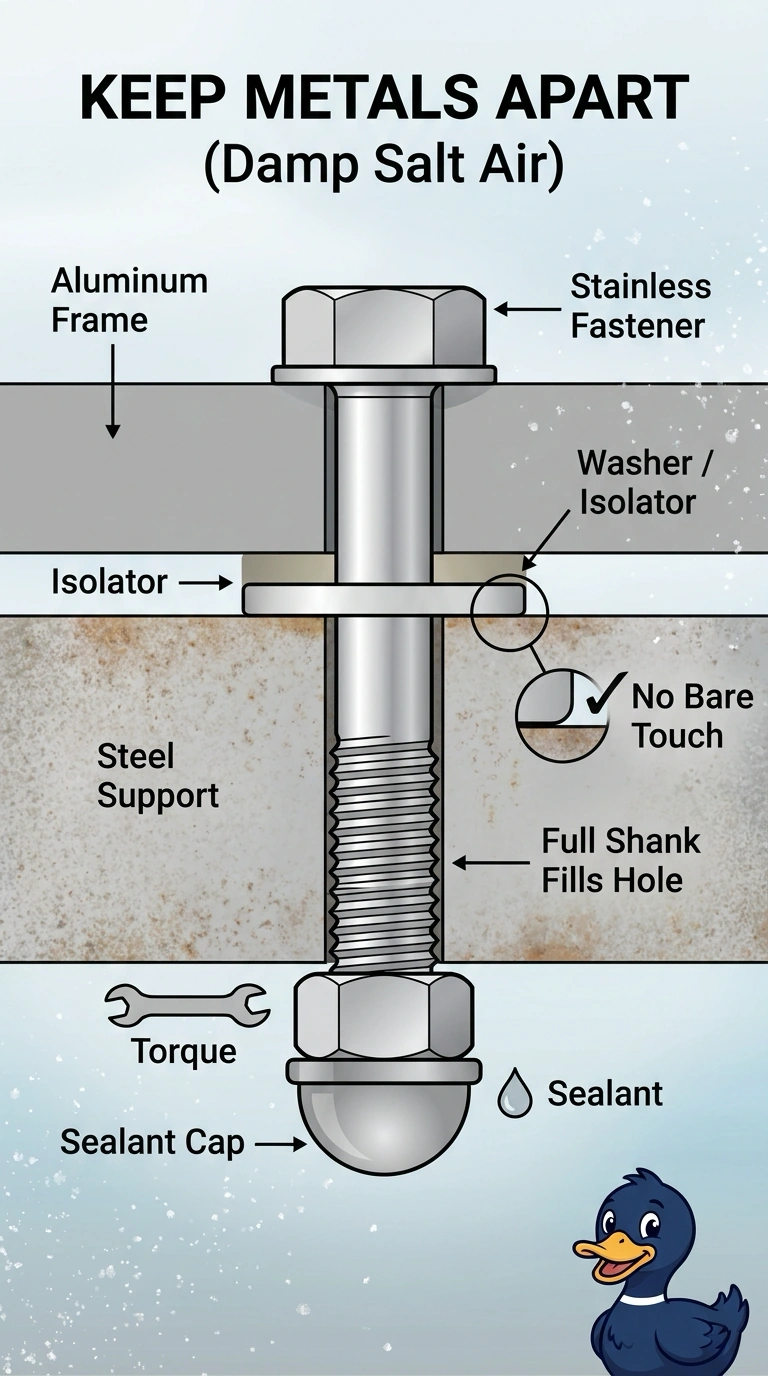
Short Explanation
Salty dew can turn touching metals into a slow battery that pits your rails. Isolation with listed stainless fasteners, isolators, and sealant helps keep the joints strong and compatible.
Full Explanation
Listed stainless fasteners provide dependable strength when correctly sized and installed, while isolators interrupt direct metal contact and sealant helps keep moisture out of the joints. Together, these measures address structural loads and galvanic-corrosion risk in damp, salt air, where the white deposits and pitting show that bare dissimilar-metal contact is already a concern. Using listed stainless fasteners and isolators but omitting sealant leaves a path for persistent dew to enter and remain in the joint, sustaining corrosion conditions. Load-rated hot-dip galvanized lag screws with isolation and sealant may seem suitable, but their zinc coating is not a reliable substitute for the specified stainless hardware in prolonged salt exposure; coating damage or degradation can expose steel and compromise durability. Listed stainless fasteners with sealant and proper embedment still leave a galvanic risk if stainless heads touch the aluminum rails directly. Exam caveat: acceptable materials and isolation details depend on the rail-system listing, local code, and manufacturer instructions; “stainless” alone does not establish compatibility. Practical check: verify the specified fastener grade, size, and embedment, and confirm isolators and compatible sealant are continuous at every aluminum-to-steel interface.