
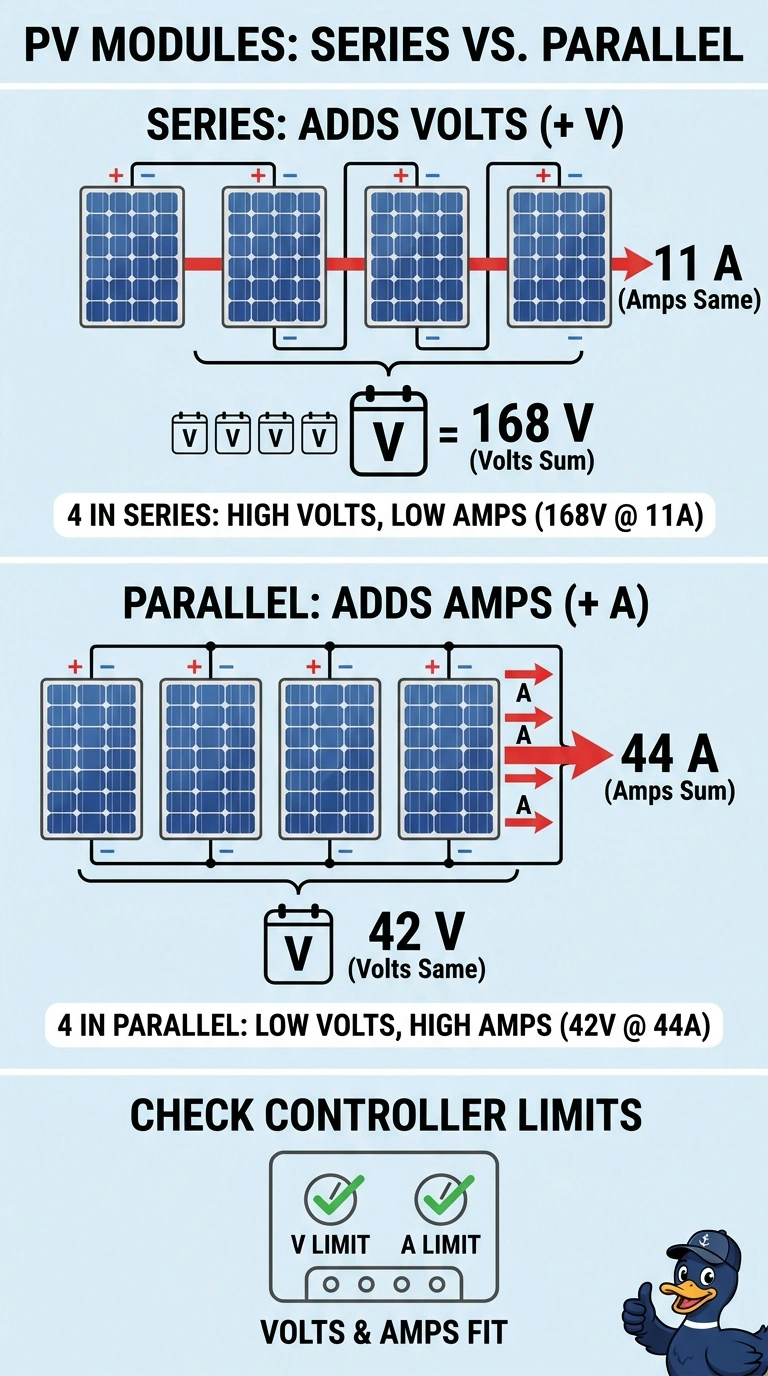
You wire four identical 42-V open-circuit, 11-A short-circuit modules for a small off-grid test, first all in series then all in parallel, using ideal values and ignoring losses. The charge controller has strict voltage and current limits. Which calculated result correctly shows series versus parallel circuit values?
Select an answer to reveal the explanation.
Short Explanation
You've got volts that stack and amps that stack, just never both at once. Series adds volts like batteries head-to-tail while parallel adds amps side-by-side.
Full Explanation
The correct result applies that series connections add voltages while current stays at one module value, giving four times 42 V at 11 A, and parallel connections add currents while voltage stays at one module value, giving 42 V at four times 11 A. Swapping the results fails by reversing series and parallel behavior and would lead to wrong controller voltage and current checks. Adding both voltage and current in series while leaving parallel unchanged fails by treating series as adding power twice and misunderstanding that current is common in series. Splitting evenly to the same middle value fails by averaging instead of applying addition rules and misses controller limit implications. Exam caveat is to confirm whether the question asks for Voc with Isc or Vmp with Imp and keep them paired, and practical check is to sketch the string, label added values, and verify open-circuit voltage stays below equipment maximum before connection.