
A small shop uses about 900 kWh per month with steady daytime fridges, and the roof fits 12 kW DC but the utility letter caps this site at 8 kW AC output. The owner wants the largest allowed bill cut without a service upgrade. Which PV system sizing choice best aligns array output against load analysis and interconnection limits?
Select an answer to reveal the explanation.
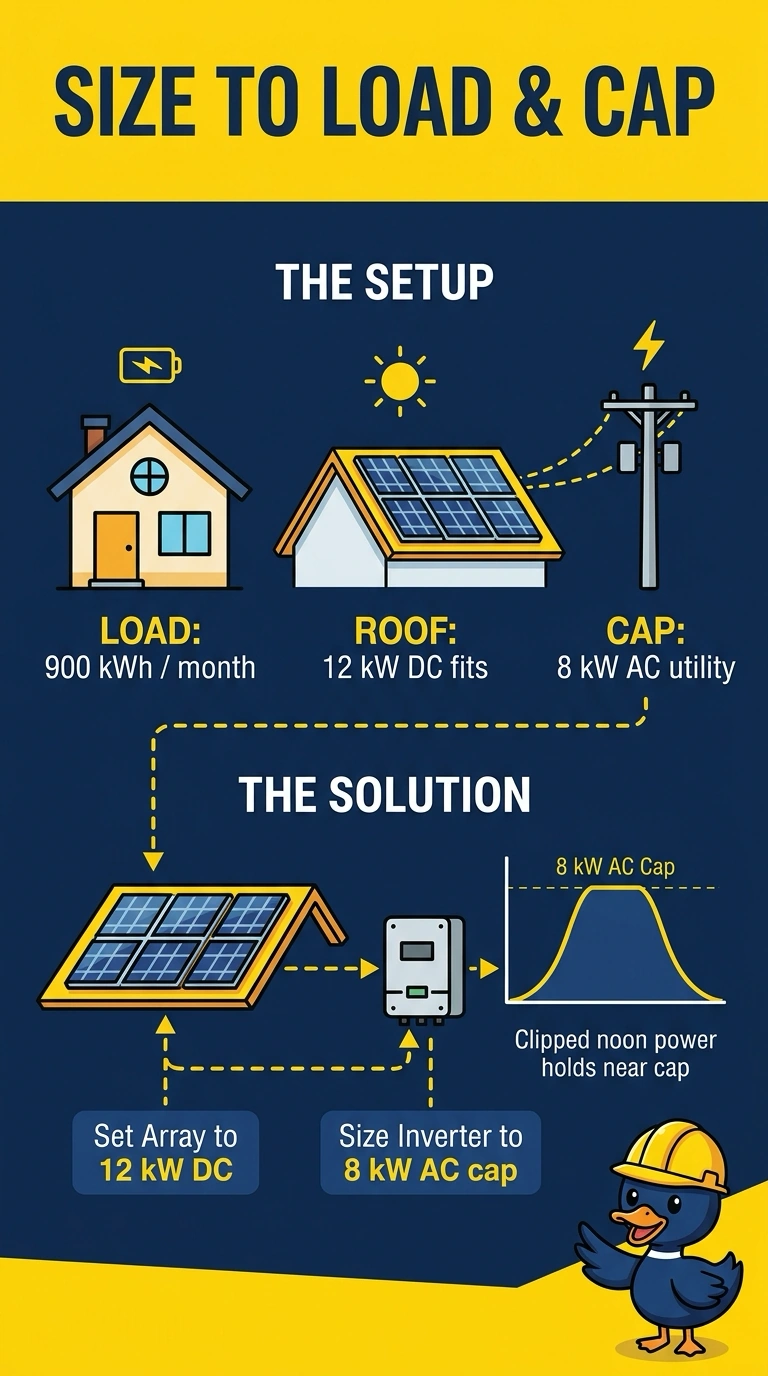
Short Explanation
You’re balancing the shop’s steady daytime use with the utility’s output limit. Size the inverter to the cap, then tune the DC array so production stays near it as long as practical.
Full Explanation
Size the inverter to the utility’s 8-kW AC ceiling and choose DC array capacity so clipped noon output stays near that cap. With steady daytime refrigerator demand, a larger DC array can produce more energy in lower-irradiance hours and hold output near the AC limit longer; some noon clipping is an expected trade-off, not necessarily wasted value. An 8-kW DC array paired with an 8-kW AC inverter uses a familiar one-to-one ratio, but it leaves part of the 12-kW roof capacity unused and may miss bill savings. Installing 12 kW DC with an 8-kW AC inverter respects the output cap, but filling the roof alone does not show that the array best matches this shop’s load; load analysis should guide sizing. Sizing an 8-kW-AC system from annual kWh alone while ignoring steady daytime fridge demand overlooks when energy is used, and an annual target cannot override the interconnection limit. Exam caveat: DC array rating and AC inverter output are distinct, so a DC rating above the AC limit is not automatically a violation if the inverter and controls enforce the approved ceiling. Practical check: model hourly production against refrigerator demand and the applicable tariff, confirm maximum AC export stays within 8 kW, and verify the utility approves the equipment and settings.