
A trainee tests a small off-grid demo with four identical 40-V, 10-A modules. First all four are wired in series, then rewired as two series strings of two modules in parallel. Which paired circuit value correctly shows the series versus parallel result for comparison?
Select an answer to reveal the explanation.
Short Explanation
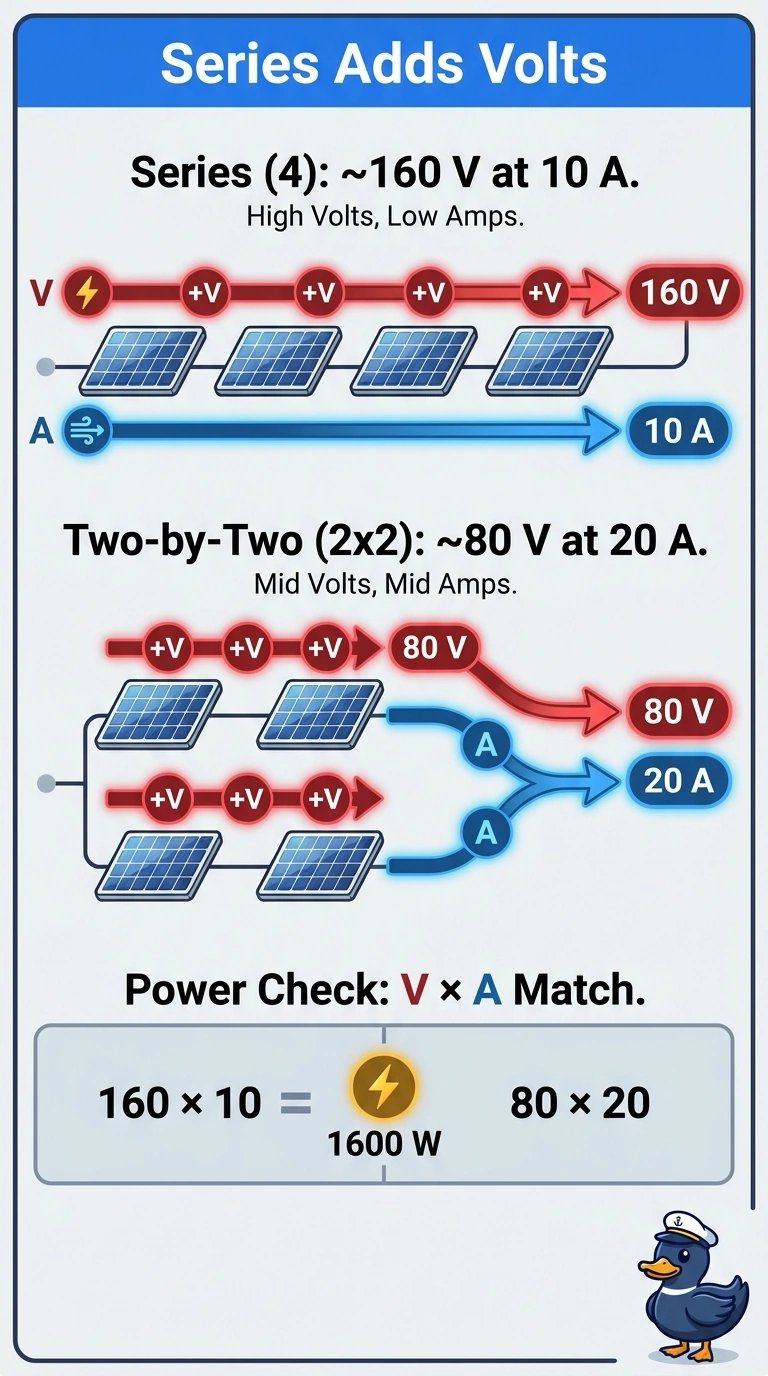
You're stacking volts in series and adding amps in parallel, so watch which grows. Total power stays near the same while voltage and current trade places, much like stacking batteries end to end versus side by side.
Full Explanation
In series the voltages add while current stays at the single-module level because the same charge flows through each module, so four 40-V, 10-A modules produce about 160 V at 10 A, and in a two-series by two-parallel arrangement each two-module string makes 80 V at 10 A, then paralleling two identical strings adds current to 20 A at 80 V. Stating series as 40 V at 40 A misapplies parallel rules to a series connection by holding voltage constant and adding current. Stating the mixed array as 160 V at 20 A misapplies both rules by adding voltage and current at once, which would double count power. Reversing the two results swaps the behaviors of series and parallel and fails to reflect that series raises voltage and parallel raises current. For the exam, check that total power is conserved when comparing correct series and parallel math, and in the field always verify open-circuit voltage and short-circuit current with a meter before assuming the wiring matches the diagram.