
You troubleshoot a daytime rooftop string with a suspected ground fault before opening the combiner, with the inverter still connected and conduit showing burn marks. The array stays live in sunlight and AC remains backfed. Which hazard assessment correctly identifies DC and AC shock, arc flash, and ground-fault risks?
Select an answer to reveal the explanation.
Short Explanation
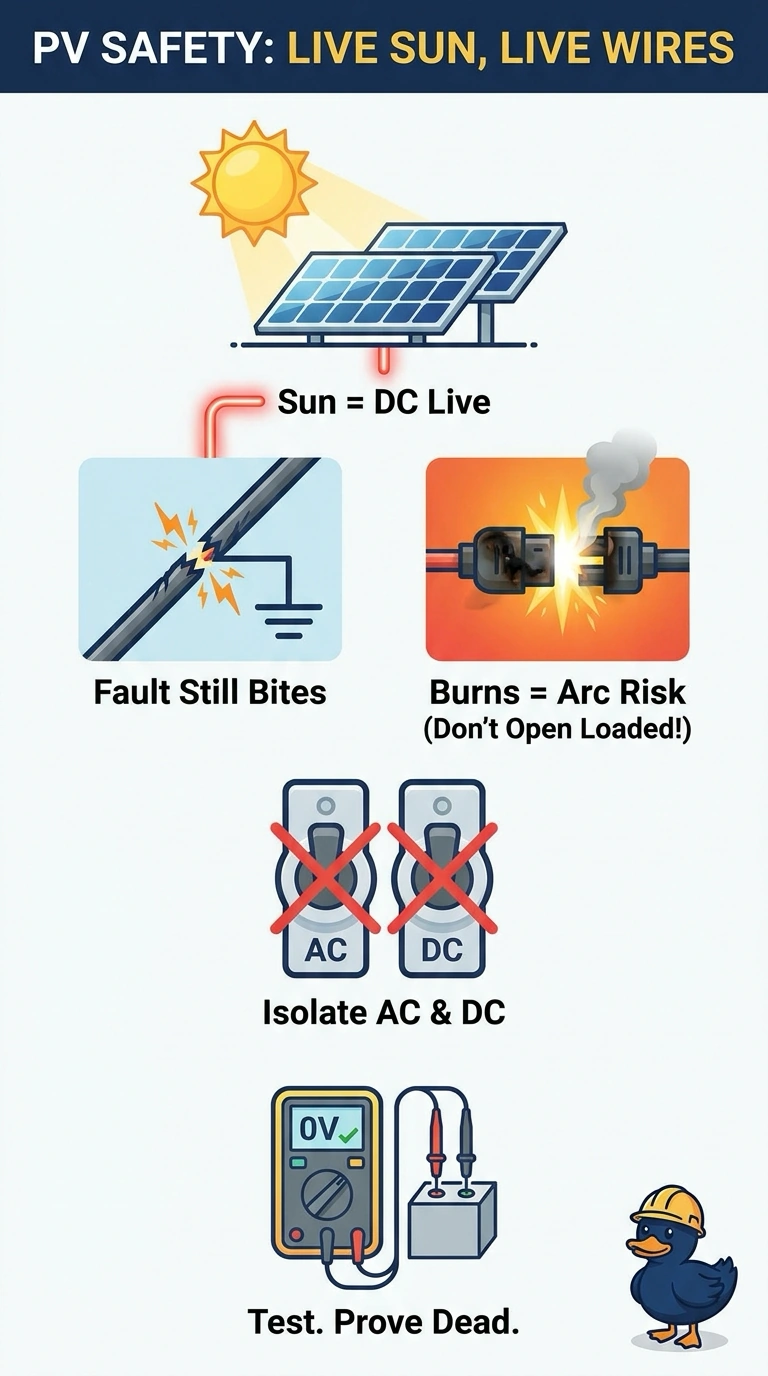
You’re dealing with sun-powered DC that stays live in daylight and AC that may be backfed, so respect both sides. Scorched wiring is a warning of possible fault and arc-flash risk, not just heat damage.
Full Explanation
The correct assessment recognizes that PV modules and strings can remain energized in daylight, AC may be supplied by a backfeed even when the inverter is stopped, and a suspected ground fault with visible scorching signals possible insulation damage, fault current, and arc-flash exposure. Isolation must address both AC and DC sources using appropriate procedures before opening equipment. Treating scorched conduit as only thermal damage overlooks its significance as evidence of damage and possible fault or arc risk. Opening the array DC disconnect and inverter AC disconnect does not necessarily eliminate utility-side AC backfeed; identify and isolate that source as well. An inverter alarm reset does not establish that a suspected ground fault has been found and corrected, so it cannot be treated as proof that the fault risk is cleared. Exam caveat: a disconnect’s position or an inverter status indication is not proof that hazardous voltage is absent. Practical check: follow site lockout and verification procedures, use appropriately rated test equipment, and confirm all identified sources are isolated before access; do not disturb scorched conductors until they have been assessed.