
At noon an installer must service a home array where one combiner shows burn marks and the inverter display is dark. The roof is bright, the rapid shutdown switch is by the main panel, and the owner asks if the roof is now safe. Which electrical safety assessment explains the risk of energized or faulty equipment including rapid shutdown?
Select an answer to reveal the explanation.
Short Explanation
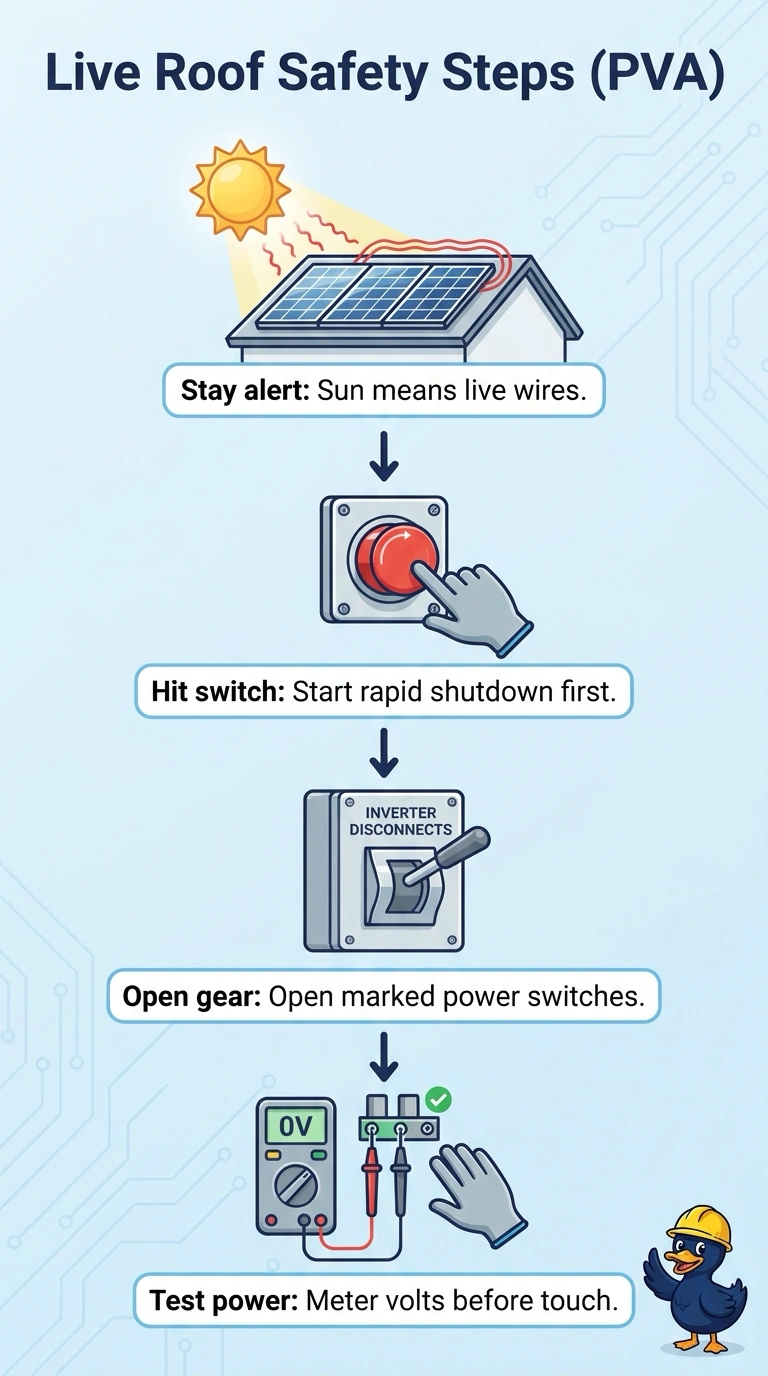
In bright daylight, you should treat the array as energized even if the inverter display is dark. Open the rapid-shutdown and inverter disconnects, then test for voltage before touching the burned combiner; shutdown is not proof that the conductors are safe.
Full Explanation
Treating the array as live in daylight, opening both the rapid-shutdown and inverter disconnects, and testing for voltage before contact is the sound assessment. A dark inverter display does not prove the conductors are de-energized, and burn marks identify the combiner as a possible fault site, so you cannot assure the owner that the roof is safe based on appearance or switch position. Waiting for the specified discharge interval and relying on a shutdown indicator may be part of shutdown practice, but neither replaces a voltage test at the conductors you will touch. Testing only at the inverter input does not establish the condition at the burned combiner, where voltage may remain or be present. Testing the combiner after opening rapid shutdown but leaving the inverter’s DC disconnect closed omits an isolation step and is not the prescribed assessment. Exam caveat: rapid shutdown reduces hazards but may not remove all voltage from every PV conductor, especially on the array side of controlled boundaries. Practical check: use appropriately rated, verified test equipment at the actual points of work, confirm the tester before and after measuring, and follow site procedures for damaged equipment.