
You service a 25-kW dusty rooftop array at noon in Arizona with warm modules, visible soiling, and prior hot connections. The manual lists connector torque values and allows only soft cleaning with low-mineral water. Which torque and cleaning practice best protects performance and connection safety?
Select an answer to reveal the explanation.
Short Explanation
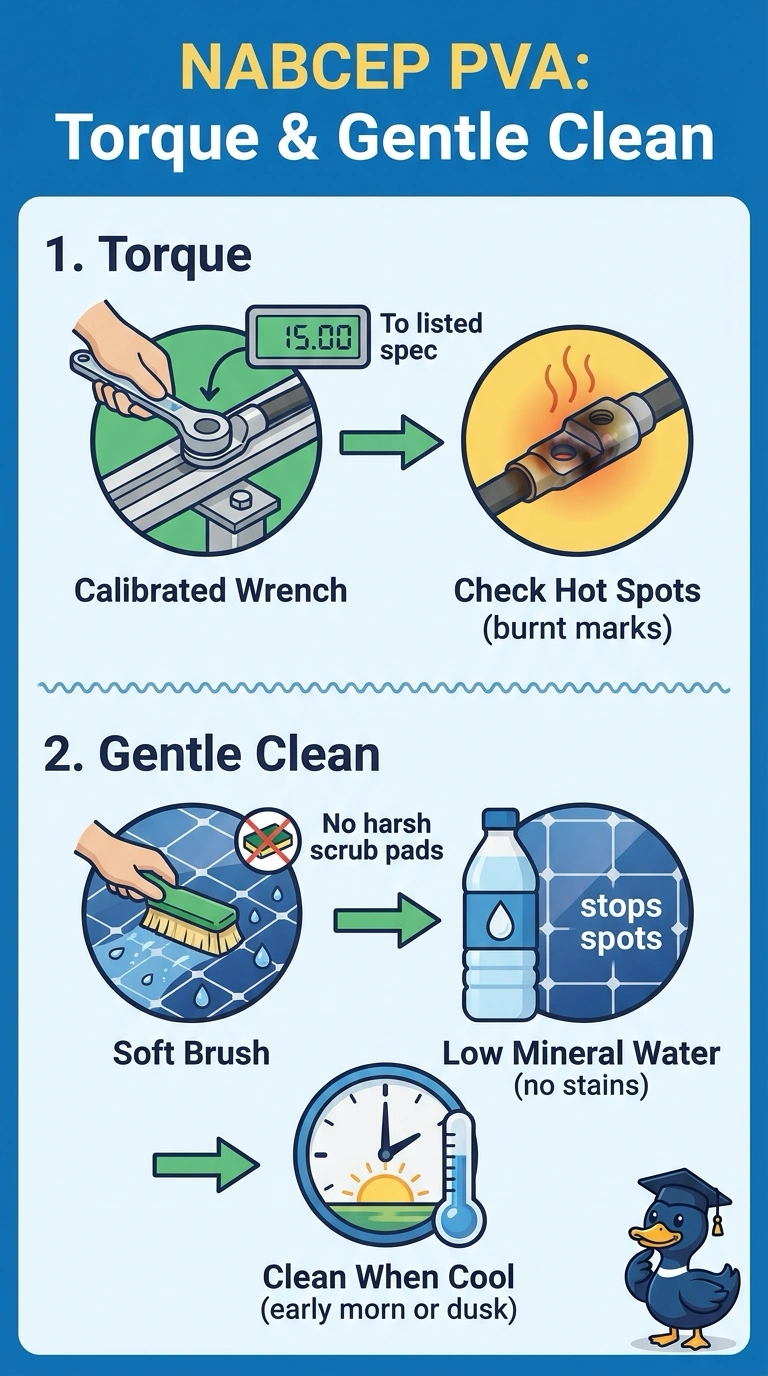
You’ve got heat, dust, and a history of hot connections to manage, so follow the manual and take your time. A calibrated wrench helps you make secure connections without overtorquing, and cool-hour cleaning protects warm modules.
Full Explanation
The correct practice follows the manual on both connection torque and cleaning: a calibrated wrench applies the specified values, reducing the risk of loose, overheated connections or damage from overtightening, while a soft brush and low-mineral water remove soiling without abrasion or mineral residue. Cleaning in cool hours limits rapid temperature changes that can stress warm modules. Brushing warm modules at midday uses suitable torque and water but risks thermal stress when water cools hot glass and materials. Using the connector maker’s general rating instead of the manual’s specified torque values is also unsuitable, because ratings can vary by component and installation. Cleaning with municipal tap water in cool hours follows the torque, timing, and brush instructions, but dissolved minerals may leave deposits as the water dries; the manual requires low-mineral water. Exam caveat: a practice acceptable for another array or under different manufacturer instructions is not necessarily acceptable here; the stated manual and site conditions control. Practical check: before work, confirm the torque value for each connection, verify wrench calibration, and check the water quality and module temperature.