
A community center wants 40 kW and shade for its lot. Its flat roof is at its load limit and needs new membrane in five years, and its side field is protected wetland that cannot be graded or trenched. The lot gets full sun and the owner will pay more steel cost for dual use. Which mount choice best fits these structural and site limits?
Select an answer to reveal the explanation.
Short Explanation
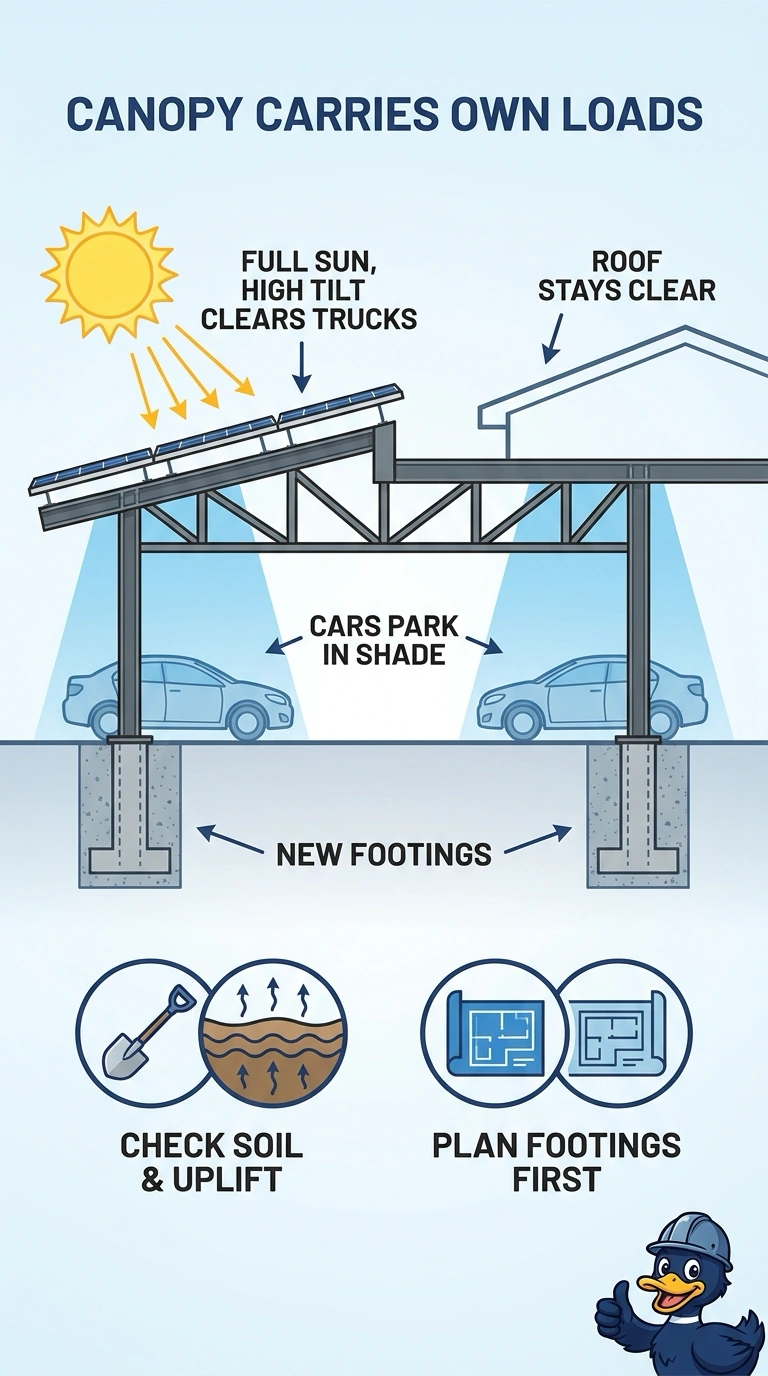
You've got a roof that can't take more weight and a field you can't touch, so the lot does double duty. A canopy sends loads to its own footings while adding shade you already want.
Full Explanation
A steel parking canopy on new footings best addresses the site and structural constraints: it can carry the array’s loads independently of the roof, provide the requested shade, and avoid both the roof membrane schedule and the protected wetland. The owner’s willingness to pay for additional steel supports this dual-use design. A 40 kW ground-mounted array on upland may be a conventional way to avoid roof loading and wetland disturbance, but it does not provide shade for the parking stalls, so it misses a key project objective. A shaded canopy sized for 35 kW uses the right mounting concept and avoids the roof and wetland constraints, but it falls short of the specified 40 kW capacity. A canopy with a direct-buried feeder is also a familiar construction approach, but routing that trench through the protected wetland violates the explicit no-trenching restriction, even if the array and footings are otherwise suitable. Exam caveat: verify whether the stated capacity is DC module rating or AC system output, since that affects array sizing but does not change the siting logic. Practical check: have a qualified designer confirm footing locations, soil capacity, utility routing, and parking-clearance requirements before finalizing the canopy layout.