
A 12-kW home addition needs plan approval in a jurisdiction that adopts the NEC with state amendments, plus local zoning setbacks and fire access pathways. The designer cites national listing, state electrical rules, and city roof access rules. Which code responsibility assignment should the designer use to show electrical, building and fire code roles?
Select an answer to reveal the explanation.
Short Explanation
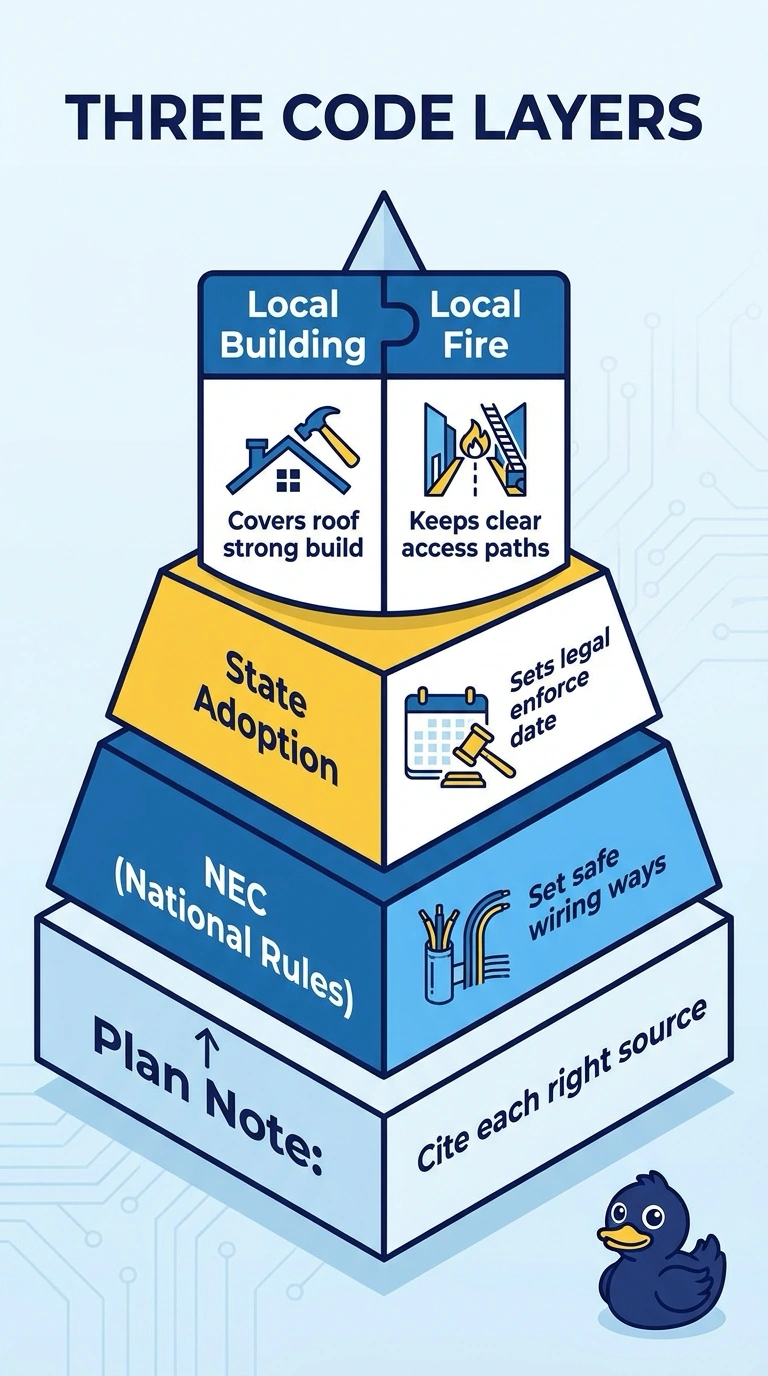
You’ve got several rulebooks in play, and sorting their roles keeps you on track. The layered-approval idea is like city, state, and league rules all applying to one game. Keep wiring under the NEC, electrical enforcement under state amendments, and structure and fire access under local building and fire codes.
Full Explanation
The assignment separates the electrical, building, and fire-code roles: the NEC supplies wiring-method rules, state amendments govern the adopted electrical requirements and their enforcement, local building codes address the structure, and local fire codes govern fire access. This keeps each responsibility with the code authority identified for that subject. The choice that treats roof setbacks as building-code requirements can misidentify the authority for siting; setbacks must also be checked under applicable local zoning rules. Assigning fire access pathways to the building code overlooks the fire-code role in the scenario. Building provisions may address related access conditions, but they do not replace review under the locally applicable fire code. National listing can show that equipment meets a product safety standard, but it does not establish installation compliance or replace state electrical enforcement; installation and approval still follow the adopted NEC and amendments. Exam caveat: code adoption, amendments, enforcement authority, and overlapping provisions vary by jurisdiction, so do not assume one code family has exclusive coverage. Practical check: verify adopted editions and amendments with the authority having jurisdiction, and confirm zoning setbacks, building requirements, and fire-access criteria with the responsible local offices.