
A school wants a 40 kW array but the main roof is shaded, old, and weight-limited while the parking lot needs shade and the field has open sun with trenching room. The board wants low roof risk, driver comfort, and easy mowing access. Which mount comparison among ground, roof, and canopy options best fits these site goals and constraints?
Select an answer to reveal the explanation.
Short Explanation
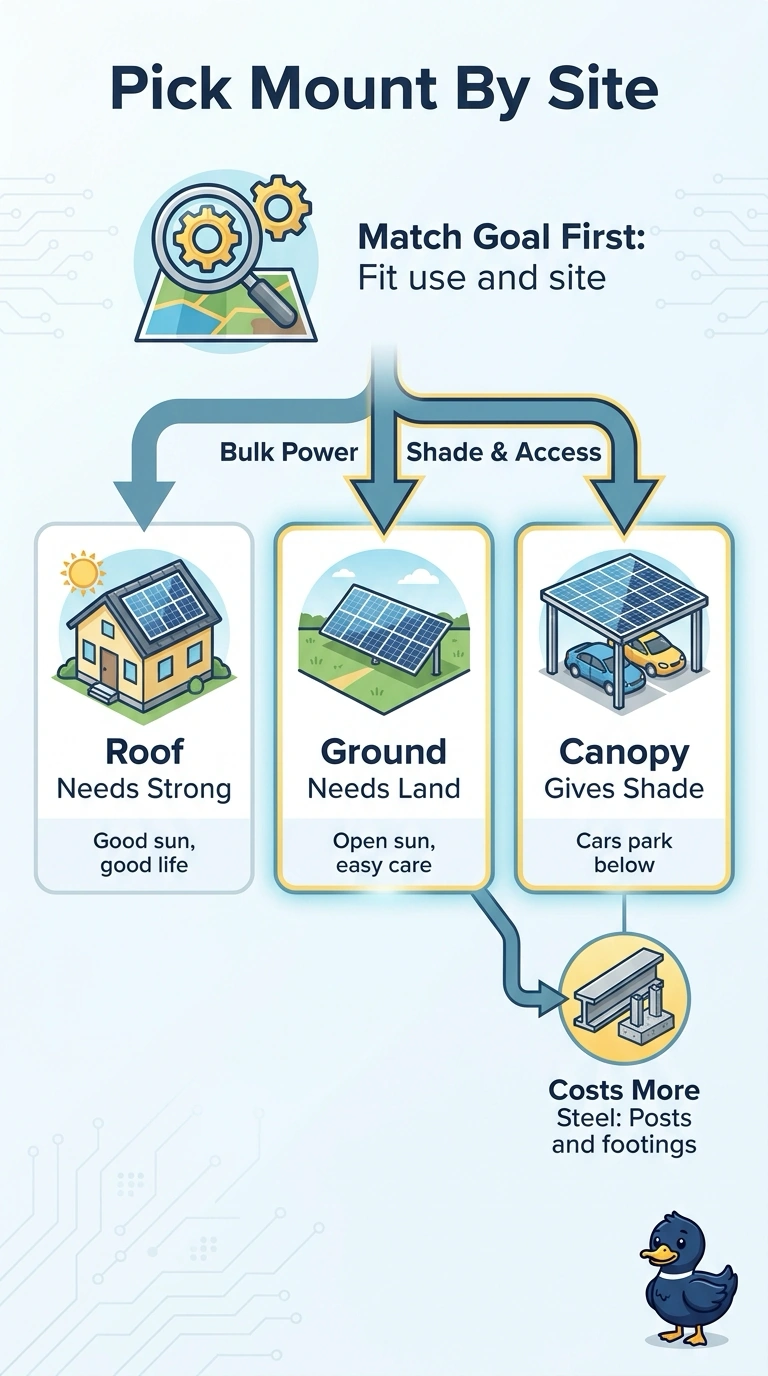
You don’t have to force the array onto a shaded, weight-limited roof: use a parking canopy to shade cars and keep access open, plus a small field ground array for bulk power with room to mow. It’s like putting each tool where it works best, with siting turning the roof’s limits into a better-fit plan.
Full Explanation
The parking-canopy and small field-array combination aligns the mounting choices with the distinct site needs: the canopy shades parked vehicles and improves driver comfort, while the sunny, trenchable field can supply most of the generation without loading or depending on the old roof. A ground-mounted system can also be laid out with clear mowing routes. A full field array with mowing lanes and trenching is a technically sound way to produce the target capacity and avoid roof work, but it leaves the parking lot without the requested shade and driver comfort. A parking canopy paired with a field array and gravel service aisles is also a conventional design, but service access is not equivalent to mowing access; without continuous mower routes, vegetation maintenance in the array area is harder. Using the canopy plus the reinforced roof may reduce the roof’s weight concern and use power electronics to mitigate shade losses, but it still places part of the project on an old, shaded roof, contrary to the goal of low roof risk. Exam caveat: module-level electronics can reduce mismatch from partial shade, but they do not remove shade or make an unsuitable roof a low-risk mounting surface. Practical check: confirm structural capacity and roof condition, then verify canopy clearances, array setbacks, trench routes, and mower turning paths on a scaled site plan.