
An O&M tech is servicing a small off-grid cabin with four flooded lead-acid batteries showing uneven run time, low specific gravity alarms, and sulfation risk after a cold week. The owner wants cell-level health before equalizing. Which battery test sequence should the tech use with load tester, hydrometer, and refractometer?
Select an answer to reveal the explanation.
Short Explanation
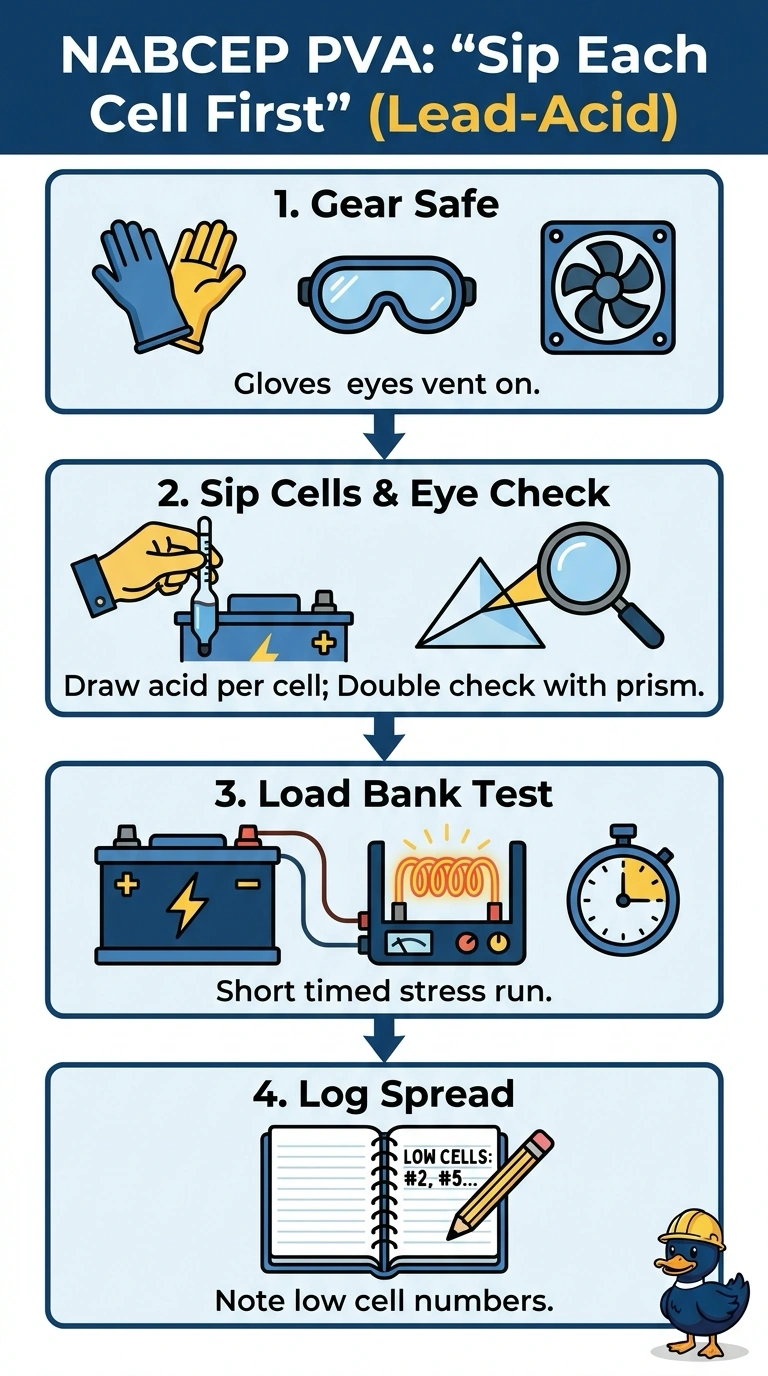
You check each cell before putting the bank under load, so a weak cell can’t hide in the middle. The gravity spread shows you where to look before the bank-wide test.
Full Explanation
The sequence starts with a hydrometer check of each cell because it directly measures specific gravity and reveals the cell-to-cell variation the owner wants to assess before equalizing. Confirming the gravity spread with a refractometer provides an independent check; the bank load test then assesses performance under load after the cell-level checks. Checking only one pilot cell cannot reveal the spread across all cells, and a bank load test alone cannot identify which cell is weak. Hydrometer-checking each cell, load-testing the bank, and only then confirming the spread with a refractometer uses all three tools but performs the bank-level test before completing the cell-level confirmation, rather than following the requested diagnostic sequence. Charging and equalizing before checking each cell also violates the owner’s explicit timing requirement, and equalization can change subsequent gravity readings. Exam caveat: specific-gravity readings depend on electrolyte temperature and state of charge, so interpret any spread using the battery manufacturer’s guidance; a spread alone does not prove sulfation or cell failure. Practical check: make sure electrolyte covers the plates, use clean instruments, and apply temperature correction or compensation before comparing cell readings. Follow appropriate precautions for flooded batteries and load testing.