
A service tech is upgrading a 6-kW string array that needs NEC rapid shutdown at the modules and has one chimney-shaded string losing morning output, with no batteries planned and the existing inverter kept. Which power electronics choice explains rapid shutdown devices and DC-to-DC converters for this retrofit?
Select an answer to reveal the explanation.
Short Explanation
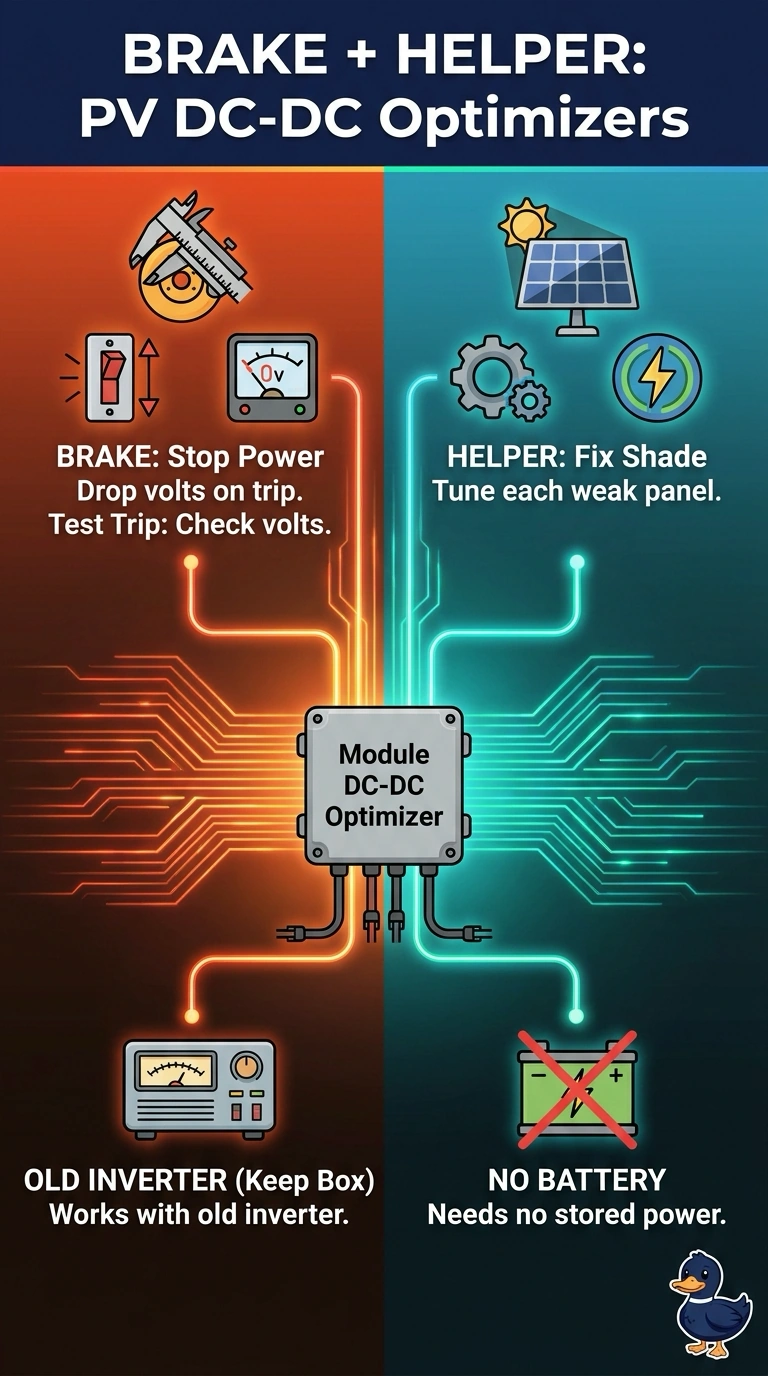
You need both a brake and a helper. Smart optimizers drop voltage for safety while tuning weak panels, like dimmers that also fix flicker.
Full Explanation
Module DC-DC optimizers are the fitting choice because they can provide module-level rapid shutdown while conditioning each module’s output to reduce mismatch from the chimney-shaded string. They operate with the existing string inverter, so the retrofit need not add batteries or replace the inverter. Listed module-level shutdown devices paired with the existing inverter can satisfy the shutdown requirement, but shutdown hardware alone does not correct the shaded modules’ mismatch; that approach leaves a stated performance problem unaddressed. Non-shutdown DC-DC optimizers can address module mismatch while retaining the inverter and avoiding storage, but they fail the requirement for rapid shutdown at the modules. Module microinverters can provide module-level shutdown and limit shading losses, but replacing the existing inverter conflicts with the stated requirement to keep it. Exam caveat: verify that the selected optimizer is listed for the applicable rapid-shutdown function and is compatible with the specific inverter; not every DC-DC converter provides shutdown. Practical check: confirm the array’s module-level shutdown behavior, inverter compatibility, and the manufacturer’s required layout and commissioning procedure against the equipment listings and the locally adopted NEC edition.