
An associate must verify zero voltage at a rooftop combiner after opening the disconnect, midday sun keeps modules live, and the meter was dropped last week on concrete. Which practice for using electrical test equipment safely best ensures a trustworthy reading?
Select an answer to reveal the explanation.
Short Explanation
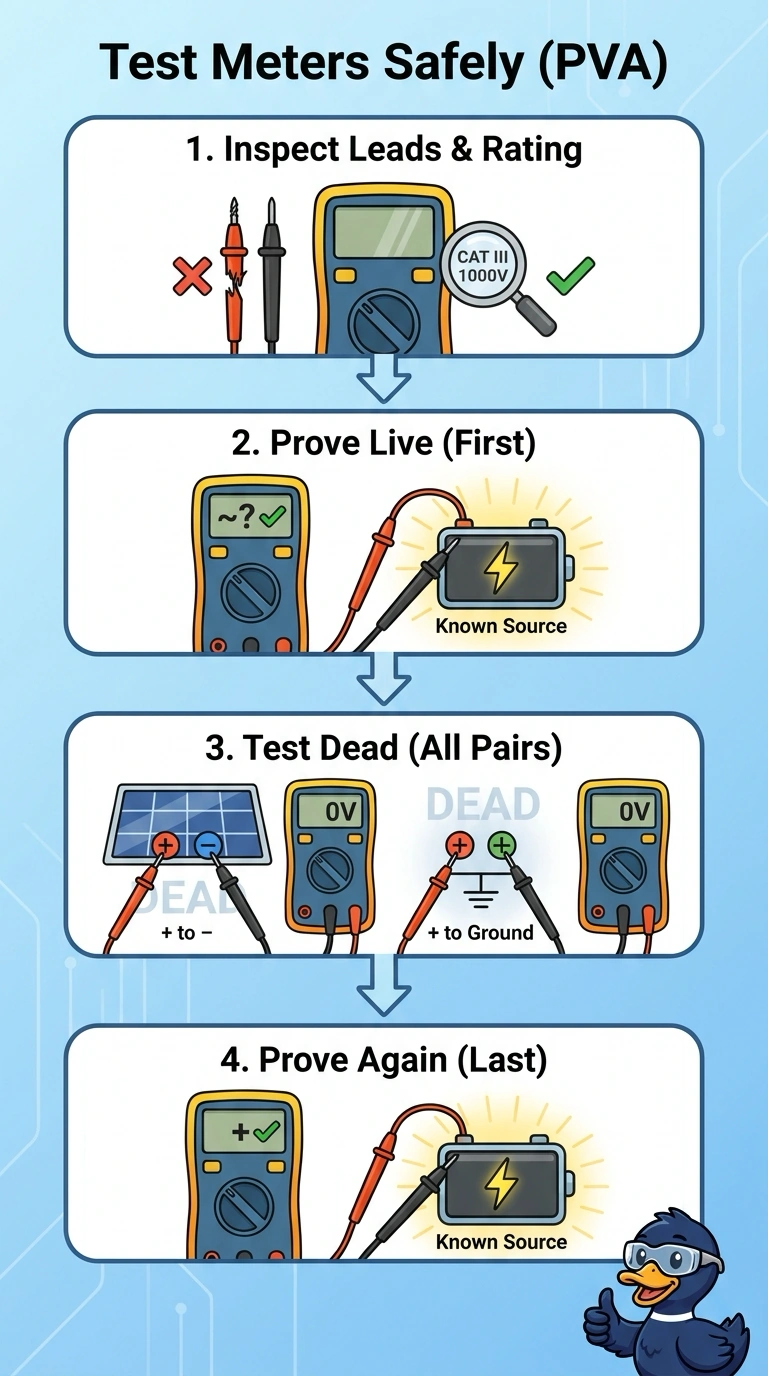
Trust your tools, and proving the meter on a known source helps you rely on its reading. Check positive-to-negative and each conductor to ground, then prove the meter again so you know it remained functional.
Full Explanation
Inspecting the leads and meter rating helps you catch damage or equipment unsuited to the installation, while proving the meter on a known source confirms it can indicate voltage before you rely on a zero reading. Testing positive-to-negative and each conductor to ground checks for voltage both between conductors and from a conductor to ground; rooftop PV modules may remain energized in sunlight after the disconnect is opened. Checking only positive-to-negative with intact, properly rated leads and a proven meter can miss voltage from a conductor to ground. Using an intact, correctly rated, recently calibrated meter for both measurement types but not proving it on a known source leaves its present response unverified, especially after a drop onto concrete. Proving the meter and checking each energized conductor to ground, but not positive-to-negative, can miss voltage between conductors. Exam caveat: follow the applicable electrical safety procedure and required PPE; an open disconnect does not by itself make exposed PV conductors safe. Practical check: after testing, prove the meter again on the known source to confirm it remained functional throughout the verification.