
A rural customer wants two days of backup for 8 kWh per day of critical loads plus daytime self-consumption, with limited roof space and frequent evening outages. Which preliminary estimate correctly sizes storage needs for backup load, autonomy, self-consumption, and load shifting?
Select an answer to reveal the explanation.
Short Explanation
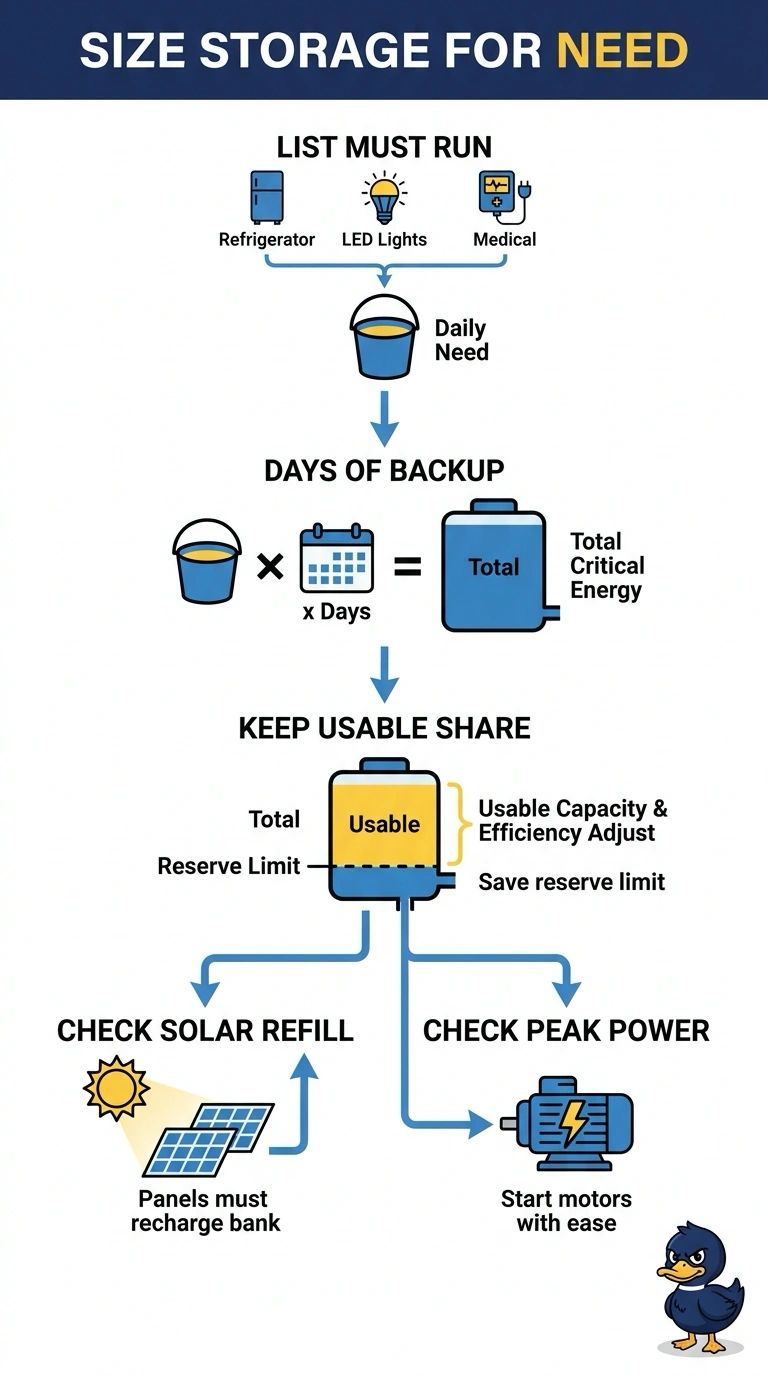
You start with what must stay on and for how long. Critical energy plus safe usable reserve points to the right bank.
Full Explanation
The correct estimate starts with the critical-load energy over the required autonomy period: 8 kWh/day × 2 days = 16 kWh delivered to loads. Battery nameplate capacity must be higher to account for the allowed depth of discharge and conversion losses. The estimate should also consider how PV or another charging source will restore the battery, whether the inverter can supply peak loads, and how daytime solar can serve loads or shift energy toward evening use. Sizing storage at 16 kWh nominal treats all stored energy as usable, so it can underprovide the required backup once discharge limits and losses are included. Estimating a two-day battery and useful PV production without checking roof fit overlooks a stated site constraint; a sound energy target does not establish that the required array can be installed there. One-day autonomy can be a reasonable economy or resilience trade-off in other projects, but it does not meet this customer's explicit two-day backup requirement. Exam caveat: preliminary energy sizing is not a final battery or inverter specification; load peaks, surge currents, temperature, and reserve settings can change equipment selection. Practical check: review interval load data and outage timing, then compare usable battery capacity and peak output with the actual loads and roof-specific PV yield.