
An associate must explain service options to a homeowner with 120-V lights and 240-V well pump, and to a shop with 208-V motors fed from three hot legs. The meter tags are unclear. Which circuit comparison of single-phase, split-phase, and three-phase supply should the associate give to guide equipment choice?
Select an answer to reveal the explanation.
Short Explanation
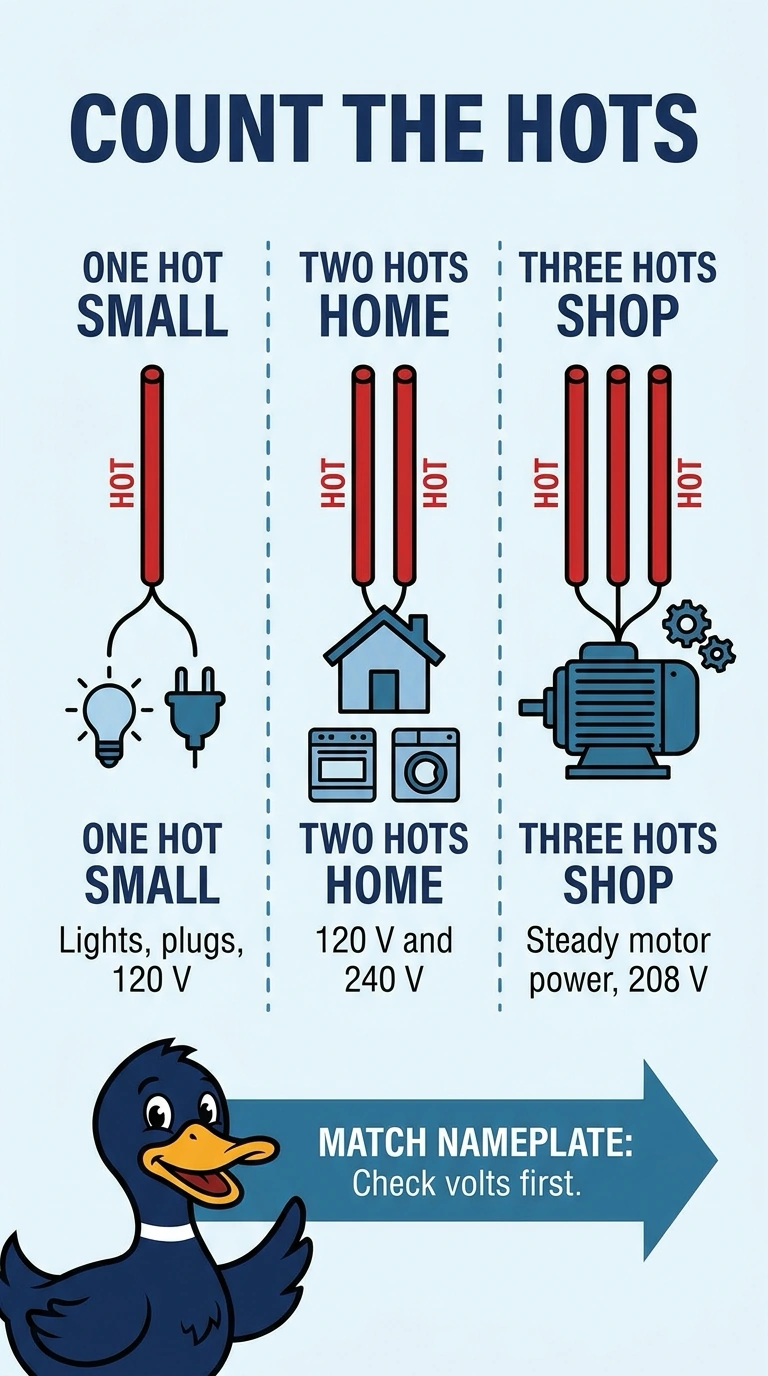
You can match equipment to the supply by counting hot legs and checking the voltage: split-phase service has two hots for a home’s 120/240-V loads, while three-phase service has three hots for the shop’s motors. Keep the phase arrangement and the equipment’s voltage rating in view when you guide the choice.
Full Explanation
The correct comparison distinguishes the supplies relevant to both customers: small single-phase loads can be served by one hot and a return, split-phase residential service provides two hot legs for 120/240-V loads, and three-phase equipment is supplied by three hot legs. This explains why the well pump’s 240-V requirement points to the home’s split-phase service, while the shop motors must be compatible with its three-phase 208-V supply. Describing the shop’s three-phase motors as 240 V gives a familiar arrangement but conflicts with the stated 208-V supply and could lead to choosing motors with the wrong voltage rating. Calling the home’s two-hot 120/240-V service single-phase and treating split-phase as merely another name collapses the categories being compared and fails to explain the two-leg arrangement. Describing the 208-V three-phase motor supply as two hots and a neutral gets the voltage right but omits the third hot leg; a neutral is not a substitute for a phase conductor. Exam caveat: “single-phase” is sometimes used broadly for split-phase residential service, so focus on conductors, voltages, and load requirements rather than labels alone. In practice, check the equipment nameplate and have a qualified person confirm the panel or meter identification and measured supply before connection.