
A trainee is assigned to a small home with a 120/240V panel and later to a shop with a 208V three-phase panel. Both sites have PV breakers, but conductor counts, neutral use, and phase relationships differ. The mentor asks what service is present before landing wires. Which circuit comparison among single-phase, split-phase, and three-phase best identifies each service?
Select an answer to reveal the explanation.
Short Explanation
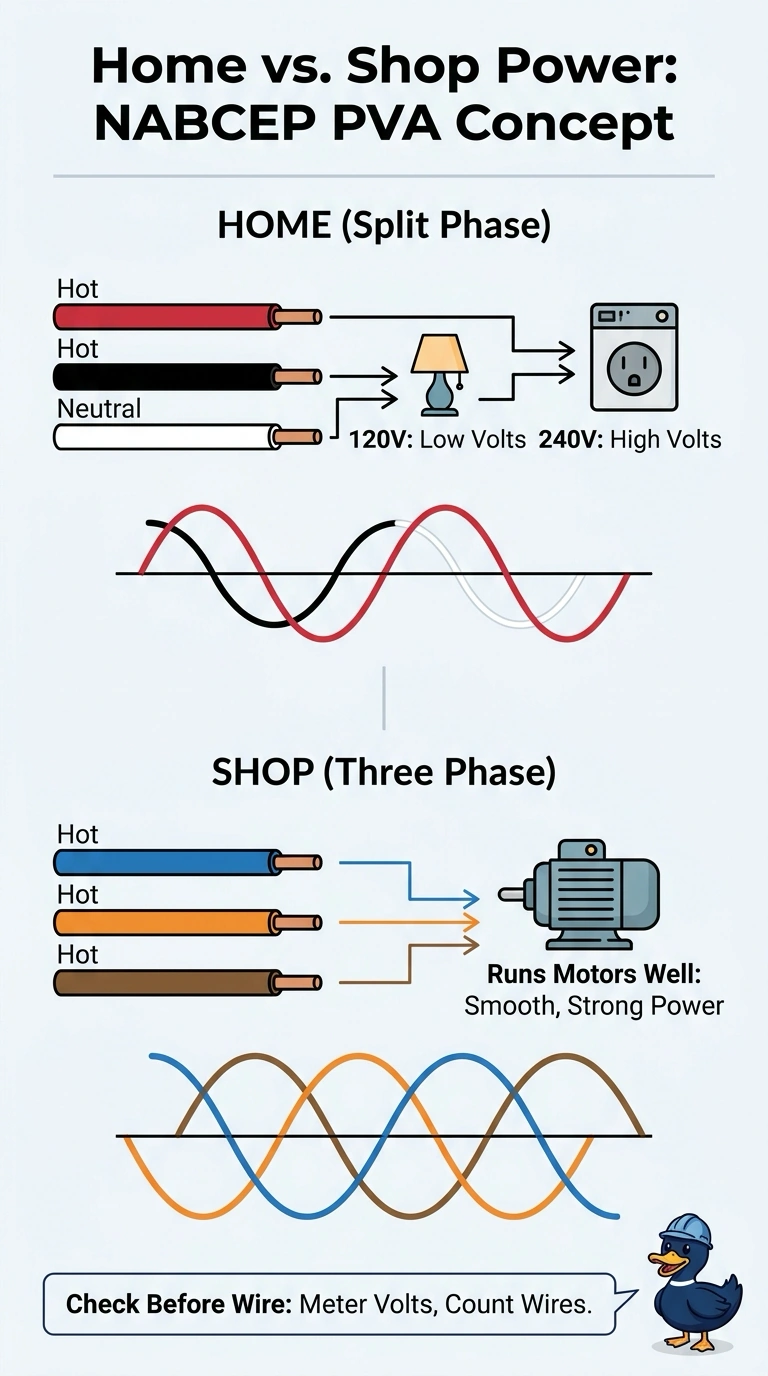
As you compare the services, count the dance partners: a 120/240V home typically has two hot legs in split-phase, while a 208V shop typically has three phase conductors. Phasing determines the voltages available, so check the service before you land wires.
Full Explanation
The correct comparison matches the stated services: a typical 120/240V home uses split-phase, with two hot conductors and a neutral, while a typical 208V shop uses three-phase, whose phase conductors are separated by 120 electrical degrees. A 240V three-phase delta service is a legitimate arrangement in some facilities, but it substitutes 240V for the shop’s stated 208V service. A 120/208V three-phase service may serve units in some multifamily buildings, but it does not identify the small home’s stated 120/240V split-phase service. A small shop may have 120/240V single-phase service for light loads, but that is not the stated 208V three-phase service; the home portion of that comparison is accurate. Exam caveat: voltage labels alone do not establish phase configuration or neutral availability. Although 208V three-phase is commonly 208Y/120V, verify the actual service rather than assuming. Practical check: before landing conductors, consult service documentation and panel labeling, then have a qualified person verify conductor identities and line-to-line and line-to-neutral voltages with an appropriate meter.