
A designer must confirm whether a proposed 15 kW DC array paired with a 12 kW inverter meets a client's 20,000 kWh annual goal. Site data for the location gives 1,700 kWh of yearly energy per installed kilowatt, and the loss budget for temperature, wiring, soiling, and conversion totals 25%. Which annual production estimate best supports the go or no-go decision?
Select an answer to reveal the explanation.
Short Explanation
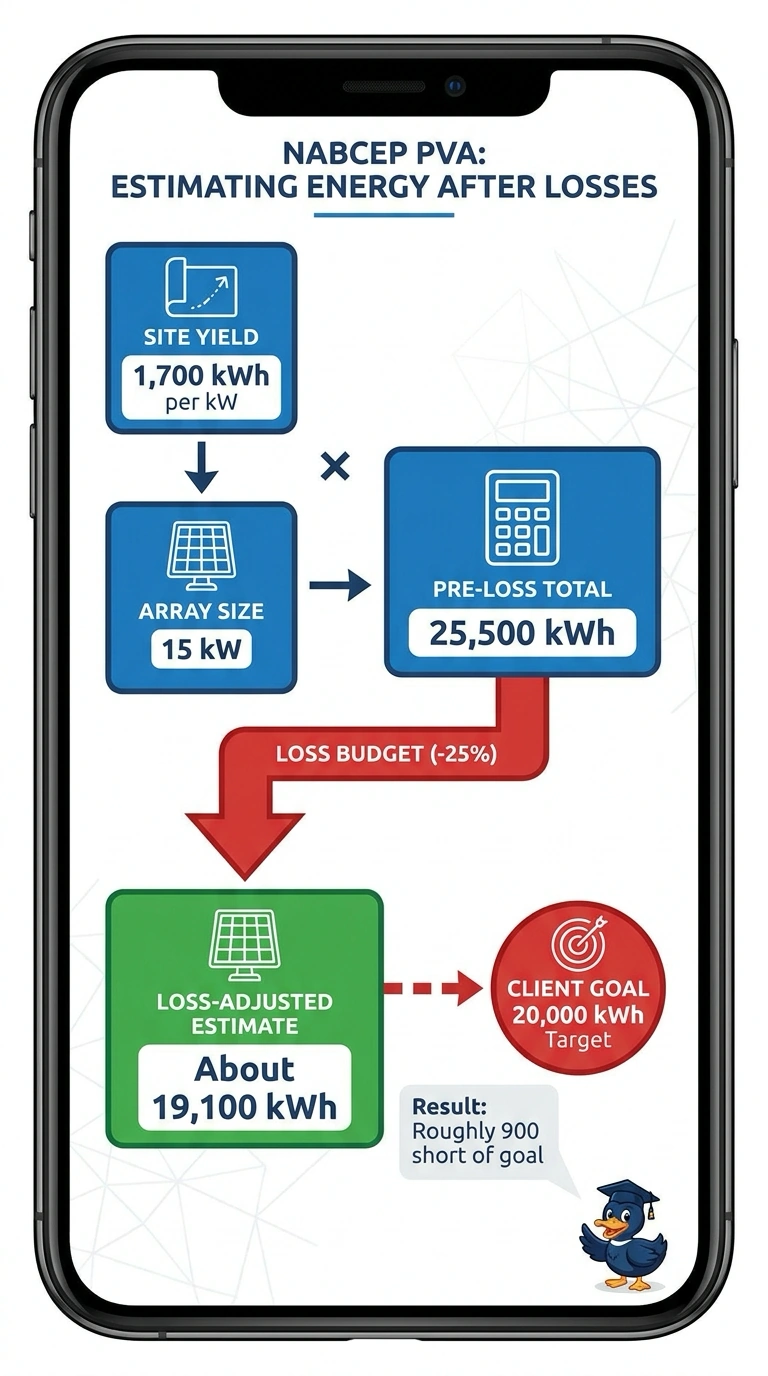
Two steps do the work: multiply the site figure by the array size, then take 25% off for everything that reduces energy on the way to the meter. That leaves the system about 900 kWh short, so it's a real gap to close before you sign anything. Your loss budget works like a coupon at the register: it comes off once, at the end, never from the shelf price twice.
Full Explanation
Annual energy estimates start from the site's raw yield and then account for losses in the chain, so 1,700 kWh per installed kilowatt applied to the 15 kW DC array gives 25,500 kWh before losses, and a 25% budget leaves about 19,125 kWh delivered. That total sits just under the 20,000 kWh goal, so the proposal misses by roughly 900 kWh and needs a small size increase or a loss reduction. Skipping the budget fails because it treats the site's gross figure as energy reaching the meter, ignoring temperature, wiring, soiling, and conversion. Applying the derate to the inverter's AC rating fails because the supplied site yield is per installed kilowatt of array; inverter size can also affect annual output through clipping, which this simplified estimate does not separately model. Shrinking the budget in practice fails because the stated loss allowance is a requirement of this estimate, not something to average away. The exam caveat is that a single annual product can hide seasonal mismatch and clipping, so check monthly as well. A practical check is to rerun the math from the other direction: divide the goal by the site figure times the loss factor to see the array size it implies.