
A small bakery pays high afternoon demand fees and faces evening outages, and asks if batteries save money beyond solar kWh. Load data show a sharp 4-7 p.m. peak. Which storage economics should the associate explain to show avoided cost and peak reduction value?
Select an answer to reveal the explanation.
Short Explanation
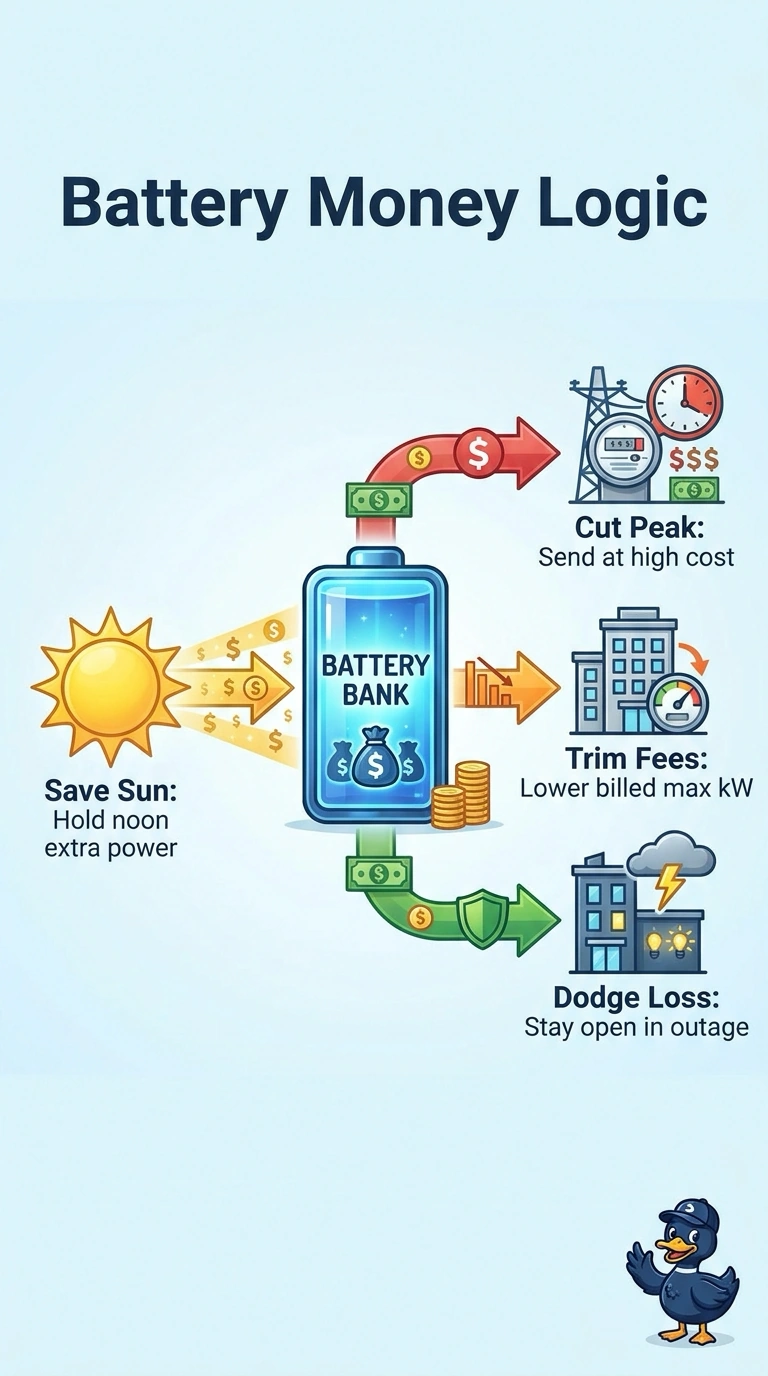
You can turn stored sunshine into bill cuts, not just more power. Peak-shaving trims the bakery’s costly 4–7 p.m. demand while backup helps avoid outage losses.
Full Explanation
Solar-charged storage that clips the bakery’s costly 4–7 p.m. peak can reduce the maximum billed kW and associated demand fees, while backup power for critical loads can avoid losses during evening outages. These are distinct value streams: shifting solar energy into evening use does not, by itself, lower the billed demand peak. A demand-managed battery that trims the peak and backs up key loads, but charges only from the grid, misses the solar-charging premise and may incur grid energy costs. Solar-charged storage that shifts energy into evening use and backs up critical loads, but does not reduce billed demand, can help with energy use and outages yet leaves demand fees unchanged. Solar-charged storage that clips the peak and cuts demand fees but values backup only for brief outages understates the outage protection the bakery wants to assess. Exam caveat: demand savings depend on the tariff’s measurement interval and ratchets, and on whether the battery can discharge through the actual peak; backup value depends on protected loads and outage duration. Practical check: compare interval load data with the tariff, then verify battery power, usable capacity, solar charging availability, and critical-load runtime.