
An entry-level tech is checking a working rooftop string wired to a string inverter that feeds a home panel. Morning readings show steady polarity at the module leads and a cycling sine at the panel feed. The lead asks why two meters are needed for one sun source. Which electrical comparison of AC and DC correctly explains the readings and test approach?
Select an answer to reveal the explanation.
Short Explanation
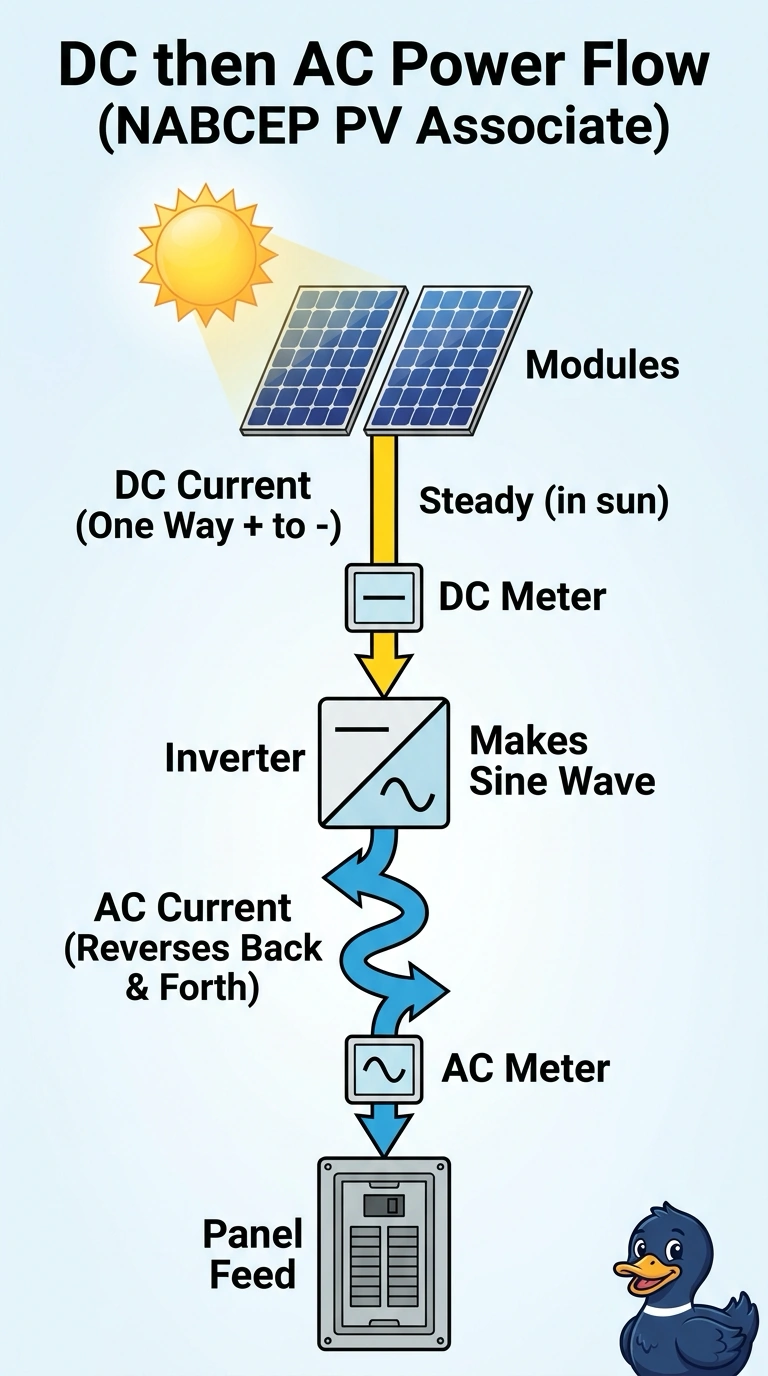
You’re seeing two kinds of current in one solar system: the modules supply DC with steady polarity, while the inverter turns it into AC that reverses through a sine-wave cycle. Polarity helps you choose the right meter mode at each point: DC at the module leads and AC at the panel feed.
Full Explanation
The module string supplies DC: its voltage has a steady polarity, so use a DC-capable meter at the module leads. The string inverter converts that DC into AC for the home panel; panel-feed voltage reverses polarity through a sine-wave cycle, so use an AC measurement there. The approach that measures DC at the modules and AC at the panel correctly matches the electrical output at each location. Measuring DC at both points assumes the inverter passes module polarity unchanged to the panel, but its panel-side output is AC. Measuring AC at both points may seem suitable because a true-RMS meter is commonly used for AC, but it misses the string’s one-direction DC polarity. Measuring DC at the modules and AC at the panel uses the right modes, but treating RMS as the sine wave’s peak confuses two different voltage values: RMS is not peak. Exam caveat: a meter’s AC mode may reject or misread DC, and a displayed RMS value is not automatically a peak value. In practice, confirm the meter’s mode and rating, verify polarity at the module leads, and use a suitable AC meter at the panel feed; follow site procedures for energized equipment.