
A homeowner is quoted a 7-kW DC array in a location averaging 5 peak sun hours daily, with an expected performance ratio of 0.78 after all losses and a south-facing shade-free roof. Which calculation correctly estimates energy production and efficiency for this proposed system?
Select an answer to reveal the explanation.
Short Explanation
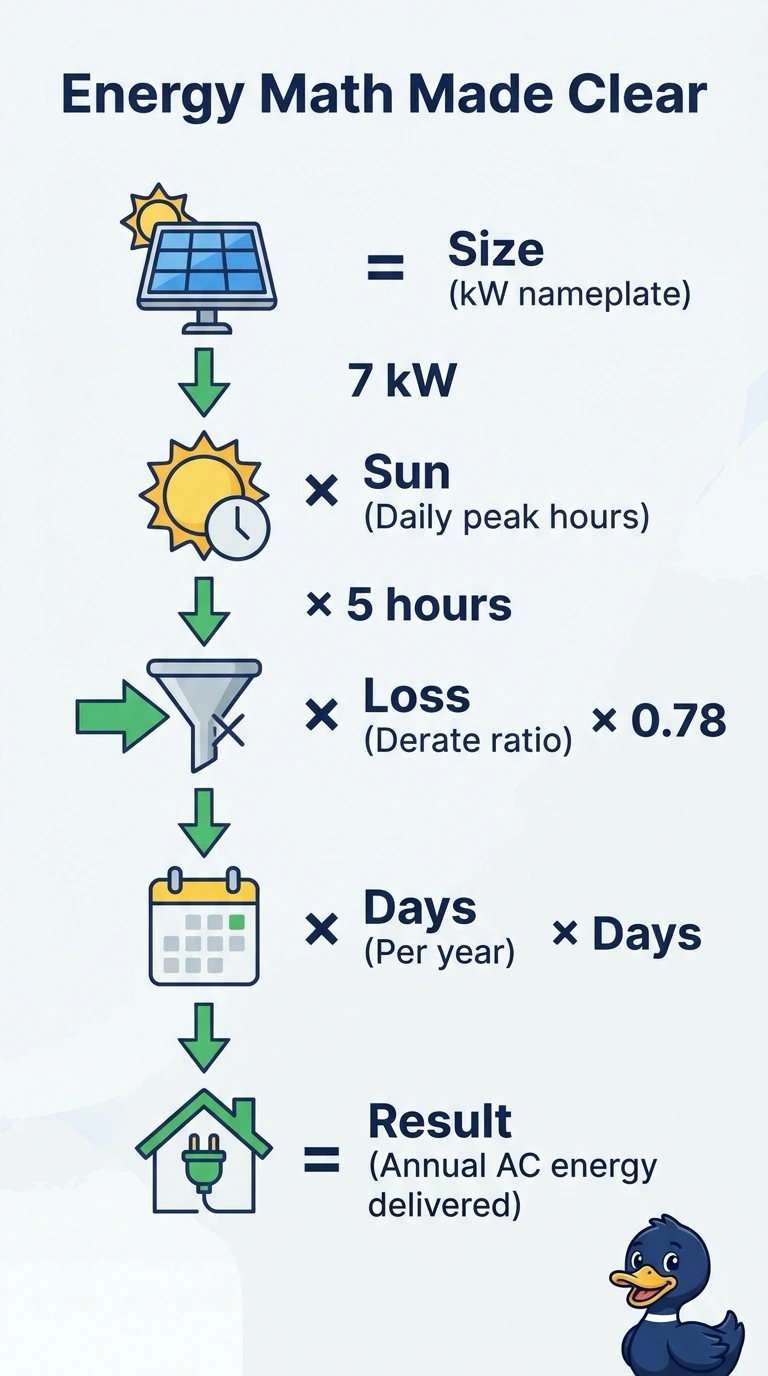
You combine the array size, daily sun, and expected losses to estimate delivered energy. With the stated performance ratio, you can estimate about 9,964 kWh of annual AC production.
Full Explanation
Use 7 kW × 5 peak-sun hours per day × 365 days per year × 0.78 to estimate about 9,964 kWh of annual AC energy. Peak sun hours represent the daily solar resource, and the performance ratio accounts for expected losses between ideal array output and delivered energy. This is an energy estimate, not a direct measure of module conversion efficiency. Multiplying by 7 kW, 5 hours, and 365 days without the performance ratio gives a preliminary pre-loss yield and overestimates delivered energy. Using 0.22 instead of 0.78 treats the implied loss fraction as the usable-output factor; 0.22 is the loss fraction, not the delivered fraction. Applying the right factors while treating the 7-kW DC rating as AC mislabels the array rating: the performance ratio estimates AC delivery from the DC array. Exam caveat: a performance ratio is not module efficiency or a substitute for peak-sun hours, and should not be applied again if a quoted yield already includes system losses. Practical check: confirm that 7 kW is the array’s DC nameplate capacity and that the performance ratio is not already included in the installer’s production estimate.