
A trainee sees DC from modules entering a string inverter and AC leaving to a home panel, the crew debates why an inverter is needed, and the foreman asks for a clear distinction for safety and metering. Which statement comparing AC and DC best guides safe handling and system understanding?
Select an answer to reveal the explanation.
Short Explanation
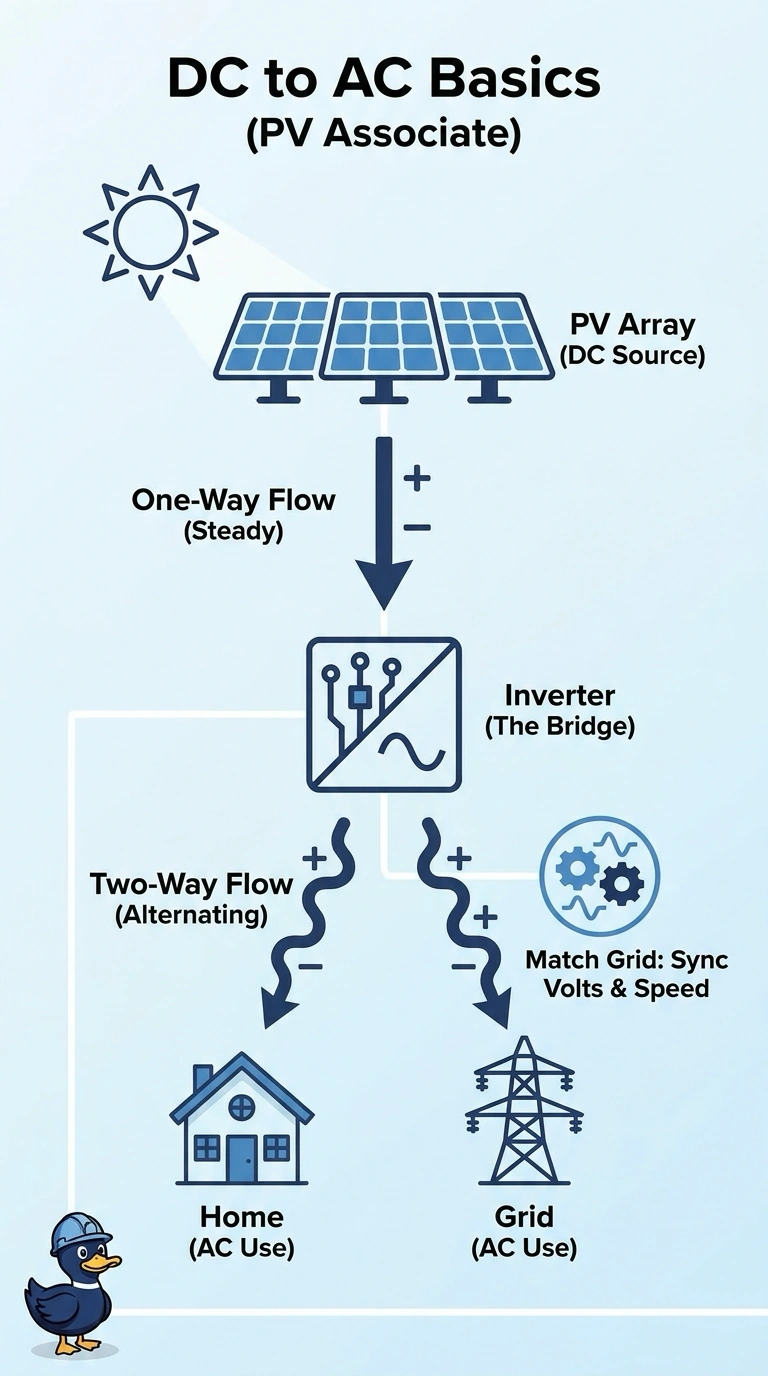
You can follow the array’s steady-polarity DC into the string inverter, where conversion produces grid-compatible AC for home loads. Keep that boundary clear as you trace the system and choose safe measurements: DC on the array side, AC at the inverter output and panel.
Full Explanation
The statement about steady-polarity DC and inverter conversion matches the system described: the modules deliver DC to the string inverter, which converts it into grid-compatible AC for home loads. This distinction helps you trace energy flow and choose measurement methods: DC measurements belong on the array side, while AC measurements belong at the inverter output and panel. Microinverters also convert panel DC to AC, but they perform conversion at each panel rather than receiving array DC at the stated string inverter. DC-coupled storage uses a controller to charge batteries from array DC, with an inverter supplying AC; that battery-and-controller path does not explain the direct array-to-string-inverter arrangement described. An off-grid inverter can convert array DC to household AC, but setting voltage and frequency alone does not make its output grid-compatible, as required here. Exam caveat: steady polarity describes DC polarity, not perfectly constant voltage; irradiance, temperature, and operating conditions affect array voltage. Practical check: use inverter labels and the wiring diagram to identify DC input terminals and AC output, and use appropriately rated test equipment and safe procedures on each side.